

Elasmosaurus
| |||||||||||||||||||||||||||||||||||||||||||||||||||||||||||
“
|
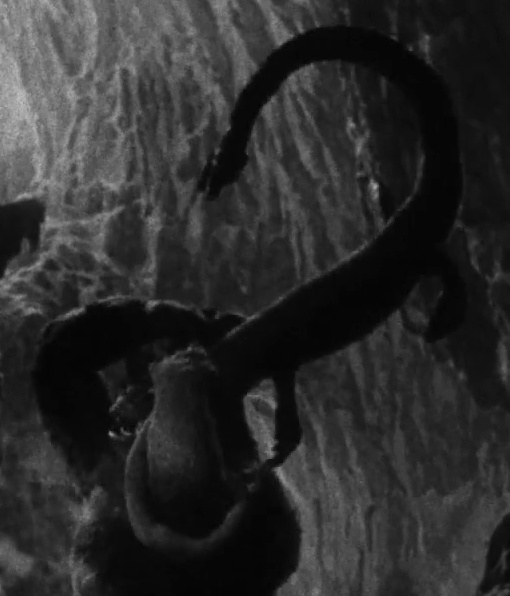
The thing from the pool looped its coils around Kong's chest, tried to ensnare his neck. For his part, Kong fought to bring his teeth to bear on those coils, tore at the monster's flesh with his hands, and struggled in a terrible silence. He gave no more challenging roars, but Driscoll could hear the rush of Kong's breath as the monster tried to squeeze the life from him.
|
„
|
— Narration during the battle between Kong and the water monster in Merian C. Cooper's King Kong (2005) |
Elasmosaurus[1][2] is an extinct genus of plesiosaur from the Late Cretaceous Period. An Elasmosaurus appears in the 1933 film King Kong.
Design
Elasmosaurus is a plesiosaur with a long neck. Its depiction in King Kong, possessing an elongated tail significantly longer than its neck, resembles the "head on the wrong end"[3] version of the creature, a depiction that was first popularized in 1869 and was later proven to be inaccurate.
History
- King Kong (1933)
- Princess from the Moon (1987)
King Kong (1933)
When King Kong brought Ann Darrow to his mountain lair, an Elasmosaurus lurking in a small body of water immediately targeted her. Kong intervened just before it could reach her. The creature wrapped its long body around Kong's neck and attempted to strangle him. Kong pulled the Elasmosaurus off with all his might and slammed it onto the rocky surface of the cave, snapping its spine and killing it.
Princess from the Moon
- Main article: Dragon (Princess from the Moon).
As a boat was sailing across the ocean, its crew witnessed the Dragon surface nearby. They began to shoot at the Dragon with harpoons, but only landed a few hits. The Dragon then rammed the ship at full speed, destroying it and killing everyone aboard.
Abilities
Physical abilities
The Elasmosaurus bit King Kong and attempted to strangle him with its tail. The second technique was more effective than the first, though he ultimately overpowered it.
Amphibiousness
Unlike its real-world counterpart, the Elasmosaurus in King Kong was willing to travel onto land to hunt for prey.
Weaknesses
The head and neck of Elasmosaurus cannot withstand powerful blows against rocks.
Books
- King Kong (1932)
- Merian C. Cooper's King Kong (2005)
Comics
- Godzilla Dominion (2021)
Godzilla Dominion
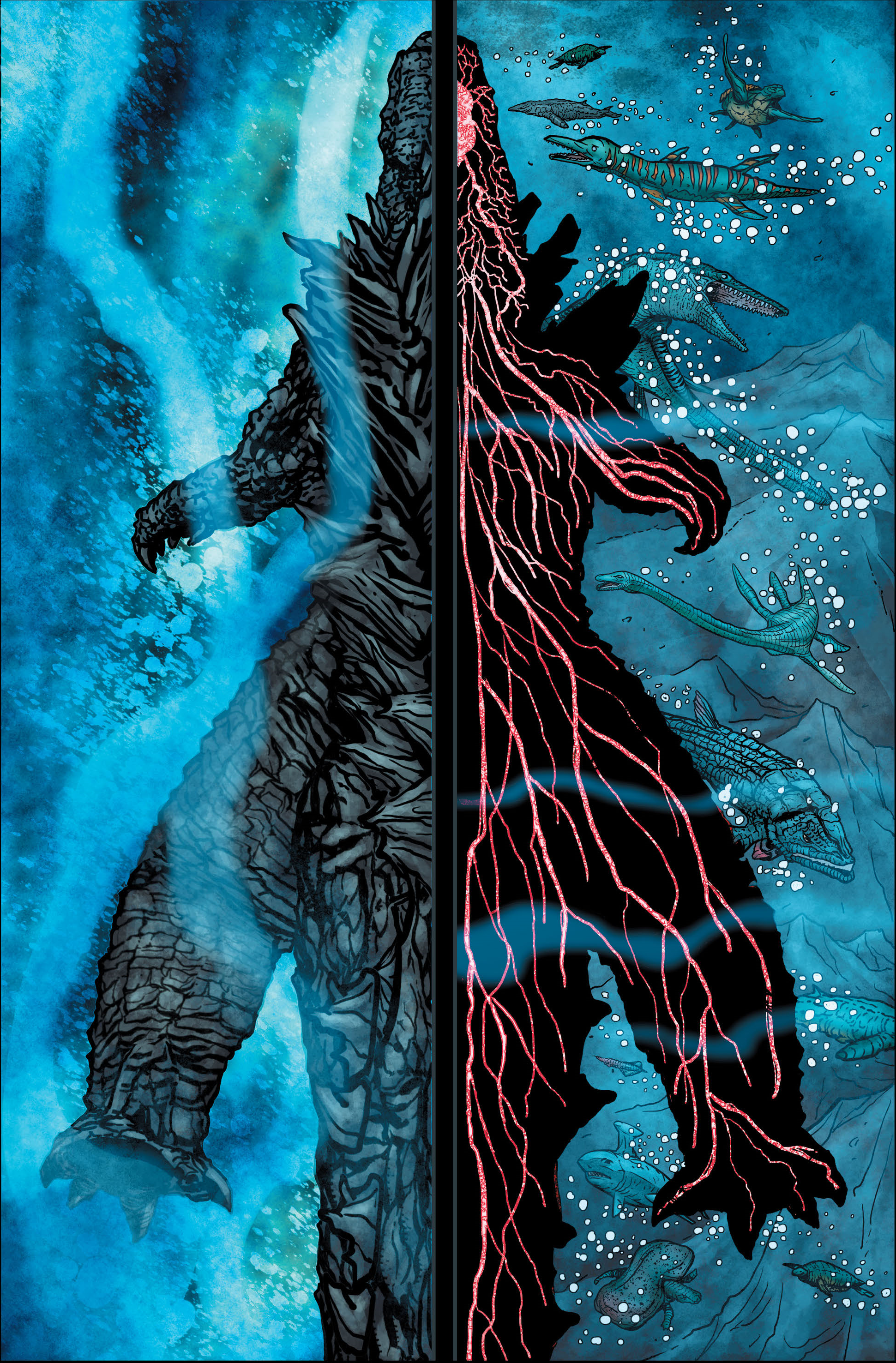
An Elasmosaurus briefly appears alongside Godzilla in a flashback, alongside several other prehistoric marine fauna.
Gallery
- Main article: Elasmosaurus/Gallery.
Trivia
- The Elasmosaurus may have inspired the other giant serpents that King Kong fought in later films, such as the Giant Sea Serpent from King Kong Escapes,[4] the giant snake from the 1976 remake of King Kong, the Warbats in Godzilla vs. Kong, and the Drownviper in Godzilla x Kong: The New Empire.
- An Elasmosaurus ("Elastomosaur") was to appear in Peter Jackson's unfilmed 1996 version of King Kong. It would have emerged from a lake near Kong's cave and killed a cowardly Venture crew member named Peek before being attacked itself by a flock of Bat-Things as Ann Darrow and Jack Driscoll made their escape. Unlike its original film counterpart, this Elasmosaurus never would have interacted with Kong.[5]
- In the video game adaptation of the 2005 film, during one level Kong must battle two giant serpent-like monsters in a cave. This level is most likely a tribute to Kong's battle with the Cave Serpent, as the way Kong kills the serpents is by slamming them onto the ground, the same way that he killed the Cave Serpent.
- The Dragon from the 1987 Toho film Princess from the Moon was identified as an Elasmosaurus in the book Godzilla Fierce Fighting Super Encyclopedia.[6]
External links
References
This is a list of references for Elasmosaurus. These citations are used to identify the reliable sources on which this article is based. These references appear inside articles in the form of superscript numbers, which look like this: [1]
|

Comments
Showing 14 comments. When commenting, please remain respectful of other users, stay on topic, and avoid role-playing and excessive punctuation. Comments which violate these guidelines may be removed by administrators.

|

|

|

|

|

|

|