

Alluring Bulb
| |||||||||||||||||||||||||||||||||||||||||||||||
“
|
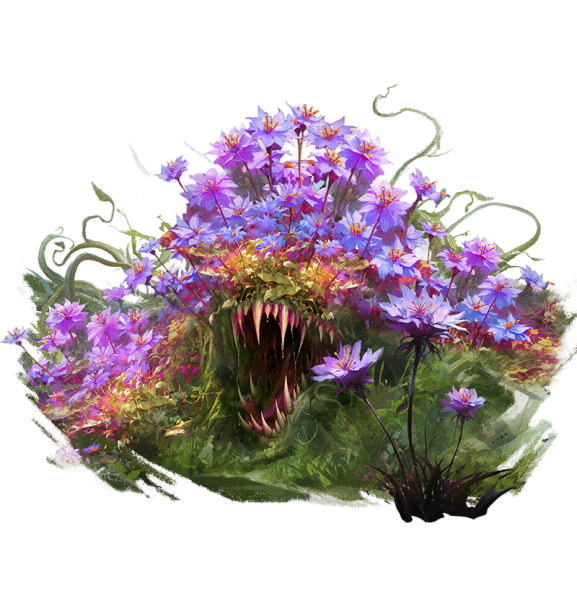
Beautiful flowers cover the ground in layers on top of leafy tresses, creating what looks like a soft patch for animals to rest upon. The flowering buds emit an irresistible fragrance that invites closer inspection. But woe to any creature foolish enough to stop and savor the aroma, for this idyllic field of flowers is, in fact, the mouth and stomach of the Alluring Bulb, a notorious Skull Island ambush predator.
|
„
|
The Alluring Bulb is a carnivorous flower superspecies that was first introduced in the 2025 Monsterverse bestiary book Kong: Skull Island - Creature Codex.
Name
The Alluring Bulb is named after the creature's means of attracting prey to itself and status as a bulb. The Alluring Bulbs' cryptozoological classification, Gloria mesmeri, comes from the genus name for the flame lily flower, "gloriosa", and the word "mesmerize."[1]
Design
The Alluring Bulb resembles a spherical membrane with jaws covered up by moss and dark-hued purple glory flower-like plants. Its mouth is filled with needle-like teeth and saliva that is the same dark magenta color as its small tongue. The creature also has tendrils similar in appearance to leafy vines that cover up the membrane which separates the mouth from the stomach.[1]
Behavior
Alluring Bulbs are carnivorous florafauna predators that reside in the scrublands and grasslands of Skull Island. They can move to suitable ambush spots by rolling. Once there, it opens its jaws wide and lays motionless. When hungry, the creature's petals open and release a hallucinogenic pollen that attracts other animals to itself. Once its victim is close enough or on top of it, the Alluring Bulb's teeth emerge from where its stigma would be and bite down, rolling over to consume its prey. The superspecies then digests them in its acid-filled stomach. As the Alluring Bulb is not suited for combat, it will quickly flee with its victim still in its mouth if they try to fight back.[1] The superspecies has been spotted hunting together in groups of four.
History
Monsterverse
Kong: Skull Island - Isle of the Damned
As the heroes and James Conrad returned to base camp, they smelled a fragrant aroma before noticing a body beside a cluster of flowers. These flowers then revealed themselves to be four Alluring Bulbs and attacked. The heroes succeeded in defeating the creatures and Conrad cut open one of them, revealing the body of a Monarch scientist they had previously encountered.
Abilities
Alluring Pollen
When hungry, the Alluring Bulb releases a pleasant-smelling hallucinogenic pollen that attracts all creatures within 30 feet to itself. Mammals perceive this scent as the one that would be the most fragrant to them, such as freshly baked goods.[1]
Tremorsense
The Alluring Bulb can sense and hear all creatures in the water or on the ground within 100 feet of it.[1]
Physical abilities
Alluring Bulbs move by rolling around. They consume their victims by biting onto them with their needle-like teeth.[1]
Camouflage
Alluring Bulbs can easily hide within their environment, as they resemble a simple patch of flowers.[1]
Durability
The Alluring Bulb's innards are more durable than its outer skin, in case their victims attempt to fight back while still inside them.[1]
Weaknesses
Alluring Bulbs are not capable of combat and will retreat if something tries to fight them. The superspecies' outer skin is slightly less durable than its innards.[1]
References
This is a list of references for Alluring Bulb. These citations are used to identify the reliable sources on which this article is based. These references appear inside articles in the form of superscript numbers, which look like this: [1]
Bibliography
- Rowan-Nelson, Awen I.; Ramsley, Chris, eds. (2025). Kong: Skull Island - Creature Codex. Evil Genius Games. ISBN 979-8-9881882-6-1.
Comments
Showing 1 comments. When commenting, please remain respectful of other users, stay on topic, and avoid role-playing and excessive punctuation. Comments which violate these guidelines may be removed by administrators.

|

|

|