

Sandbox:Nineteen
| |||||||||||||||||||||||||||||||||||||||||||||||||||||||||||||||||||||||||||||||||||
“
|
„
| |
— Taglines |
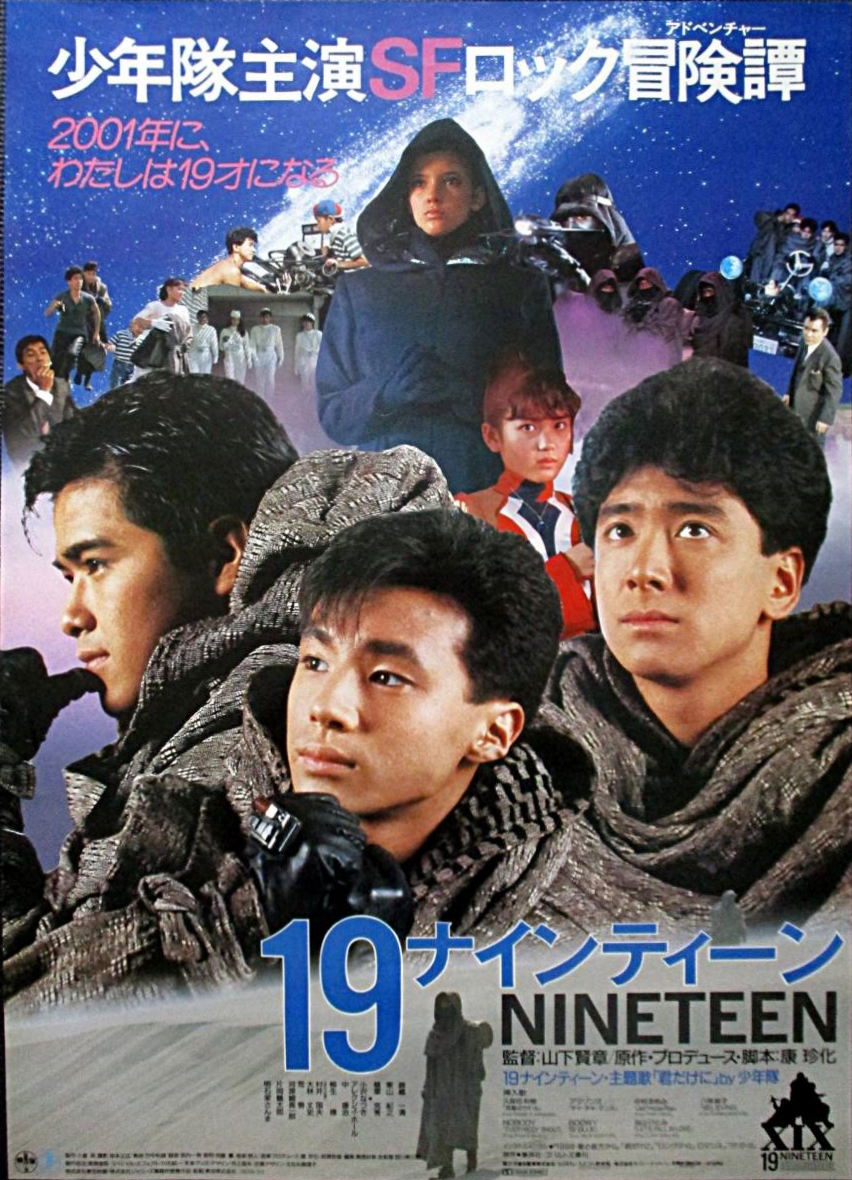
Nineteen (19ナインティーン Naintīn, lit. "19 Nineteen") is a 1987 Japanese tokusatsu science-fiction idol film directed by Kensho Yamashita and written by Kan Chin Fa, with special effects by Koichi Kawakita. Produced by Toho Pictures with special effects produced by Toho Eizo, it was sponsored by talent agency Johnny & Associates. The film stars Noriyuki Higashiyama, Kazukiyo Nishikiori, and Katsuhide Uekusa of the boy band Shonentai, who were managed by Johnny, along with Natsuki Ozawa, Teppei Yamada, Hiroshi Yagyu, Koji Naka, Toru Sakai, and Alexis Hall. It was Yamashita's second and penultimate outing as director and his first of two collaborations with Kawakita, preceding Godzilla vs. SpaceGodzilla (1994). Toho released it to Japanese theaters on August 1, 1987.[refs 1]
Plot
|
“I knew that『plot』wasn't up to much.” This plot synopsis is missing or incomplete. Please help by editing this section. |
|---|
To be added.
Staff
Staff role on the left, staff member's name on the right.
- Directed by Kensho Yamashita
- Written by Kan Chin Fa
- Associate writer Toshihiko Kawai
- Executive producer Hitoshi Ogura
- Produced by Kan Chin Fa, Yoshinori Tsutsui
- Music by Nobito
- Theme song "Just for You"
- Performed by Shonentai
- Lyrics by Kan Chin Fa
- Composed by Kyohei Tsutsumi
- Arranged by Koji Makaino
- Insert songs by Toshinobu Kubota, Amazons, Ayumi Nakamura, Junko Yagami, NOBODY, BOφWY, Hitomi Toyama
- Cinematography by Masahiro Kishimoto
- Edited by Yoshiyuki Okuhara
- Production design by Kazuo Takenaka
- First assistant director Tsunesaburo Nishikawa
- Director of special effects Koichi Kawakita[6]
- Monster design by Tomonori Kogawa
Cast
Actor's name on the left, character played on the right.
- Noriyuki Higashiyama as East, Time Patroller and Carmilla hunter
- Kazukiyo Nishikiori as West, Time Patroller and Carmilla hunter
- Katsuhide Uekusa as South, Time Patroller and Carmilla hunter
- Natsuki Ozawa as Miyako Takeda, teenage girl / Shanghai waitress
- Teppei Yamada as Yoritomo Takeda, Miyako's younger brother
- Hiroshi Yagyu as Inspector Fukazake, police detective
- Koji Naka as Zebra, Space Paratroops' android Carmilla hunter
- Toru Sakai as Turbo, Miyako's boyfriend
- Alexis Hall as Sophia, space vampire Carmilla-19
- Choichiro Kawarasaki as news anchor
- Sanma Akashiya as man in Scotch Candy commercial
- Karen Hammer as woman in Scotch Candy commercial
- Naoko Isamu as punk shop employee
- Kazuo Ide as Katayama, news reporter
- Arase as portly tactical officer
- Takeshi Obayashi as police officer talking on radio
- Tsurutaro Kataoka as pedestrian with umbrella
- Robert Vigneau as tramp in Paris
- Kunio Murai as Miyako and Yoritomo's father (photos)
- Rie Asano as Miyako and Yoritomo's mother (photo)
- Maiko Kawabe as young Miyako (photo)
- Atsuko Nakanishi
- Eiko Fujiki
- Yumi Fukiage
- Masaaki Toyokawa
- Ayumi Hirose
- Yumiko Fujimaki
Appearances
Monsters
|
Weapons, vehicles, races, and organizations
|
Development
Production
Nineteen and its cofeature Totto Channel were budgeted at a combined ¥800 million, of which ¥150 million went toward advertising.[7] According to director Kensho Yamashita, the budget for Nineteen specifically was "very low," being twice that of his first film, The Troubleman (1979), but eight times less than that of his third, Godzilla vs. SpaceGodzilla (1994).[8] Principal photography lasted about 40 days, from March 2 to April 30, 1987.[9] The first day of filming was dedicated to the movie's opening scene, with the Nakatajima Sand Dunes in Hamamatsu standing in for Uzbekistan.[10] An electric fan with the propeller from a Cessna aircraft was used to create an artificial sandstorm.[11]
Nineteen was the first collaboration of Yamashita and special effects director Koichi Kawakita, who would reunite for SpaceGodzilla.[3] Of the two films, Kawakita commented, "The[y] are very different from each other. Nineteen is a teen idol movie. However, the manner in which [Yamashita and I] worked with each other did not change very much. Our intentions both times were to attract young people and take a new approach".[12] According to Yamashita, however, "very few of the scenes in [Nineteen] were shot by the special effects staff".[8] Unlike most of Kawakita's work from the 1980s on, the film's credits do not acknowledge Kawakita as a director, instead titling him tokushu kōka (特殊効果, lit. "special effects"), a term typically reserved on Toho productions for pyrotechnics staff. Kawakita nonetheless credited himself as the movie's "director of special effects" (特技監督 tokugi kantoku) in his 2010 autobiography The Spirit of Tokusatsu.[6]
Gallery
- Main article: Nineteen/Gallery.
Alternate titles
- 19 Nineteen (literal Japanese rendering)
- 19 (alternate rendering)
- XIX (alternate rendering)
U.S. release
No official release of Nineteen in the U.S. has been documented.[5] An English fansub by Geopoliticz and TOY was uploaded to the YouTube channel TOY VIDEO on November 30, 2024.[13]
Box office
Distributor Toho hoped for the double bill of Nineteen and Totto Channel to earn ¥1.5 billion in rentals. An issue of the Motion Picture Times (Kinema Junpo) released on the films' opening day estimated that the pair could easily reach ¥1 billion, citing the appeal of their stars Shonentai and Yuki Saito, and positive word of mouth.[7] While data on their final returns is not available, they could not have earned more than ¥1 billion, as they failed to chart among the 1987 Japanese releases which exceeded this figure.[14]
Video releases
Toho Video VHS/Betamax (≥1987)
- Tapes: 1
- SRP: ¥13,800
- Audio: Japanese
Toho Video LaserDisc (July 21, 1988)[15]
- Discs: 1
- SRP: ¥8,980 (+ ¥269 tax)
- Audio: Japanese
Novelization
A novelization of Nineteen written by Kei Saito (ISBN 4-08-611058-X) was published by Shueisha two months ahead of the film, on June 15, 1987.
Trivia
- The Carmillas are named after the 1872 Irish novella Carmilla, a vampire story which predated Dracula. Like Carmilla-19, its titular character is a female vampire.
- Noriyuki Higashiyama, who plays East, has the kanji for "east" (東 higashi) in his surname, while Kazukiyo Nishikiori, who plays West, has the syllables nishi in his surname, which is the pronunciation of the kanji for "west" (西).
Notes
- ↑ The National Film Archive of Japan reports the length of a 35mm release print of Nineteen in its collection as 8,500 feet, for a runtime of 94 minutes.[1] The film's VHS and LaserDisc releases claim a runtime of 95 minutes. Yet other sources state the film runs 98 minutes,[2] 107 minutes,[3] or 108 minutes.[4]
- Grouped references
References
This is a list of references for Nineteen. These citations are used to identify the reliable sources on which this article is based. These references appear inside articles in the form of superscript numbers, which look like this: [1]
|
Bibliography
- "Production Notes". Nineteen (theater program). Toho. 1 August 1987.
- Kuroi, Kazuo, ed. (1 August 1987). Motion Picture Times. No. 965. Kinema Junposha. 20723-8 – via Google Books.
- "Production Notes". Nineteen (LaserDisc liner notes). Toho Video. 21 July 1988.
- Ui, Hisayuki, ed. (20 August 1994). Distributed by Toho Special Effect Films 1954–1994. Kindaieigasha. 65429-63.
- Ishii, Hiroshi (1997). "Nineteen". Japanese SFX and Fantasy Movies. Keibunsha. ISBN 4-7669-2706-0.
- Saeki, Makoto, ed. (24 December 1999). The Godzilla Chronicles Ver. 3. Takeshobo. ISBN 4-8124-0581-5.
- Galbraith IV, Stuart (2008). The Toho Studios Story. Scarecrow Press. ISBN 978-0-8108-6004-9.
- Kawakita, Koichi (22 January 2010). The Spirit of Tokusatsu: Toho Special Effects Battle Chronicle. Yosensha. ISBN 978-4-86248-515-1.
|
| ||
Comments
Showing 6 comments. When commenting, please remain respectful of other users, stay on topic, and avoid role-playing and excessive punctuation. Comments which violate these guidelines may be removed by administrators.