

Daimajin (1966)
| Daimajin media | |||||||
|
|
| |||||
| |||||||||||||||||||||||||||||||||||||||||||||||||||||||||||||||||||||||||||||||||||||||||


“
|
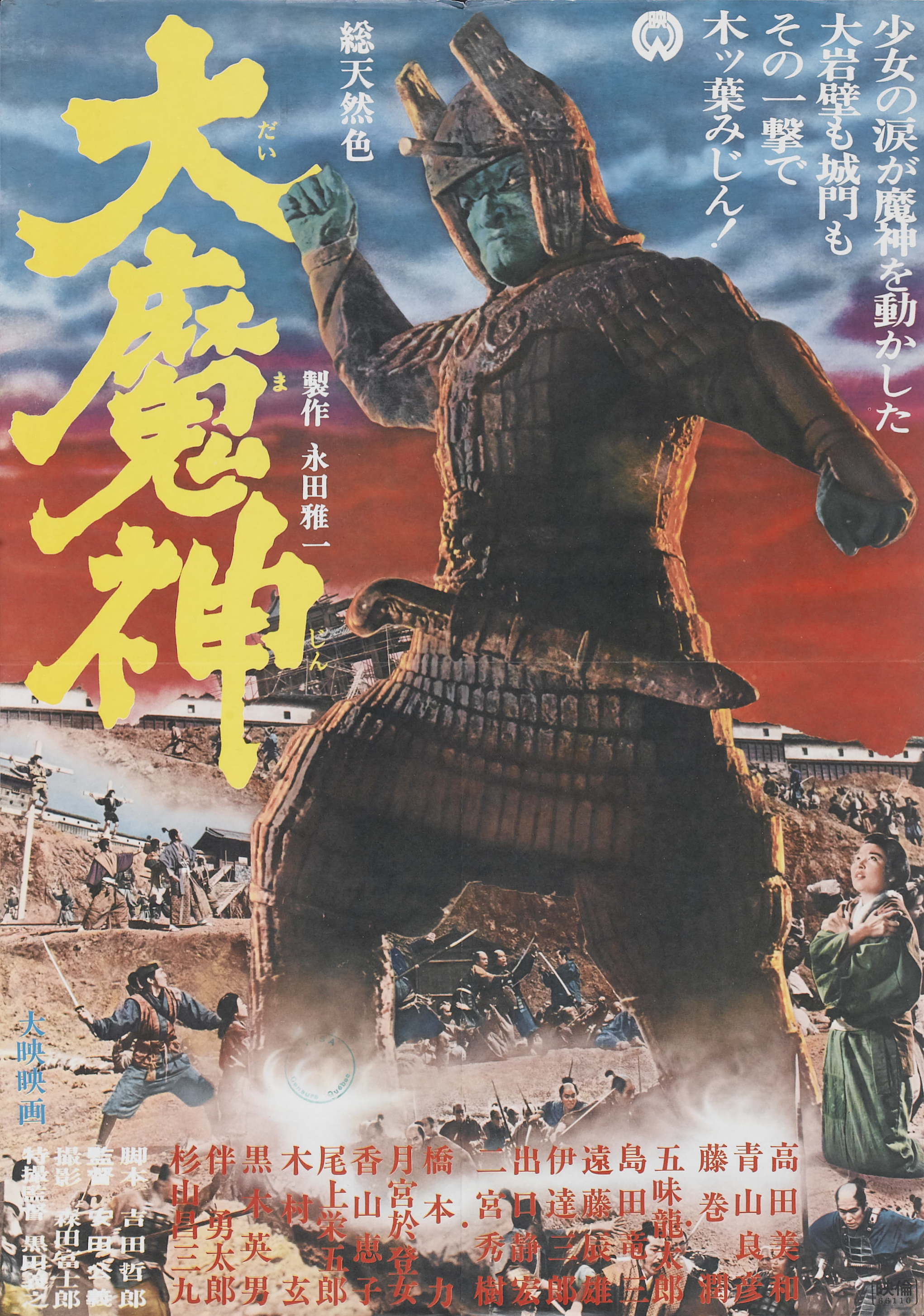
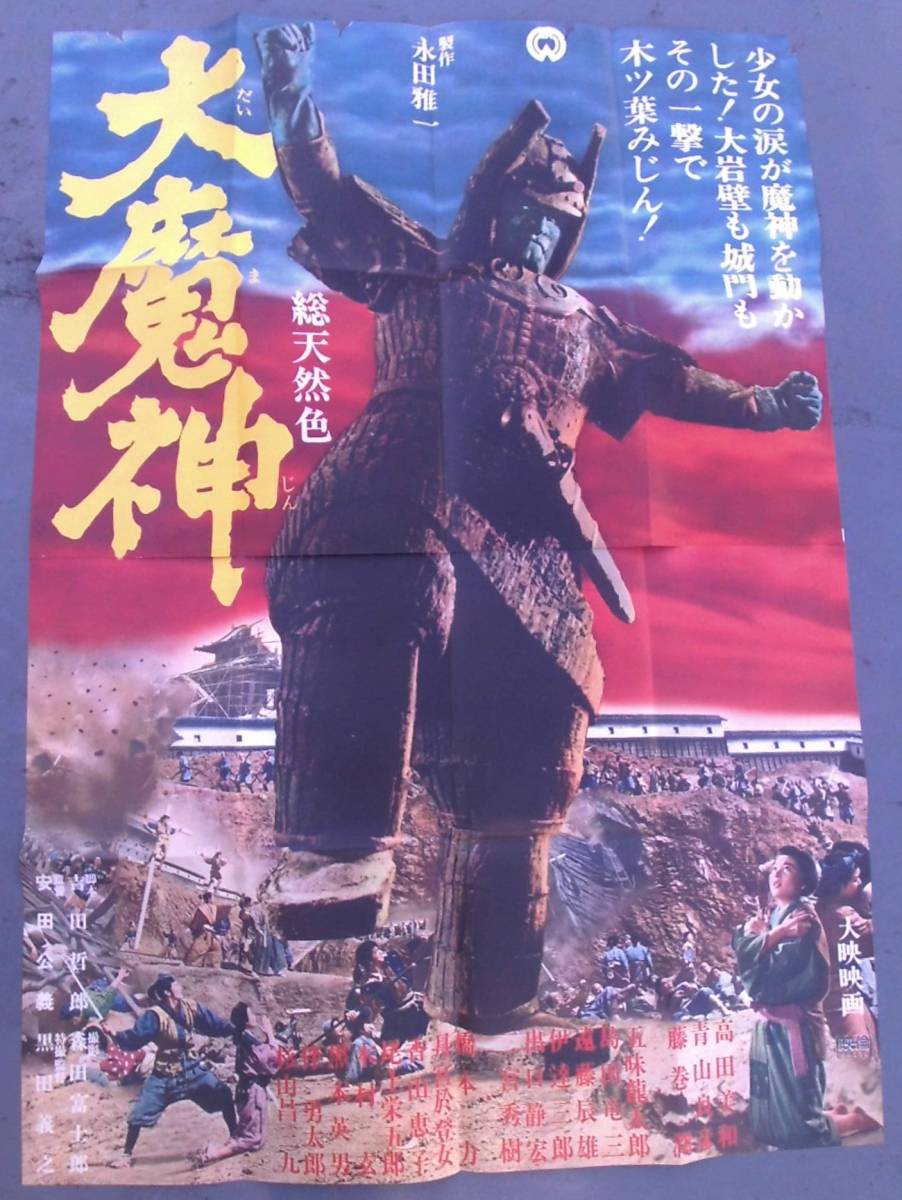
The girl's tears moved the evil spirit, and with one blow, the huge rock wall and the castle gate were smashed to pieces! (少女の涙が魔神を動かした大岩壁も城門もその一撃で木ッ葉みじん!)
|
„
|
— Japanese tagline |
“
|
SEE THE HORROR OF A VILLAGE CRUSHED BY THE REVENGE OF HELL
|
„
|
— International tagline |
“
|
The restless fury of a violent warrior god is unleashed against the violators of his shrine
|
„
|
— American tagline |
Daimajin (大魔神 Daimajin, lit. "The Great Devil") is a 1966 tokusatsu historical fantasy film directed by Kimiyoshi Yasuda and written by Tetsuro Yoshida, with special effects by Yoshiyuki Kuroda. Produced by Daiei Kyoto Studio, it is the first entry in the Daimajin trilogy. It stars Miwa Takada, Yoshihiko Aoyama, Jun Fujimaki, Ryutaro Gomi, Ryuzo Shimada, and Tatsuo Endo. The film was released to Japanese theaters by Daiei on April 17, 1966, on a double bill with Gamera vs. Barugon.
Plot
In Sengoku-era Japan, large tremors send villagers scattering, as they fear that an ancient spirit named Arakatsuma is beginning to wake up. The entire village then gathers at their shrine to pray that it will remain imprisoned. This torchlit ceremony, led by their priestess Shinobu, is observed by the local feudal boss, Lord Hanabusa, who respects the beliefs of his villagers, but does not believe in the Daimajin. Hanabusa then sends his chamberlain named Samanosuke down to the ceremony to provide a sense of security, but Samanosuke uses the distraction as a means of staging a coup. He kills Hanabusa and began to storm the castle.
A loyal vassal named Kogenta Sarumaru goes to protect Hanabusa's children, Tadafumi and Kozasa Hanabusa, and prepares to smuggle them out of the kingdom. They make their way to a stable with the help of some other vassals, but are cornered by Samanosuke's guards. They begin to burn the stable down, and the vassals make a vow to meet back in town in 10 years from that day. Kogenta and the children escape the building, but have to be cautious of guards as Kogenta takes them to his aunt Shinobu's house. They hide from the soldiers when they come to search the house, and when they are gone, Shinobu takes them up Majin's Mountain and leaves them in a cave that is believed to have once been the home of their god, on the assurance that Samanosuke's men will never look there.
Ten years later, Kogenta goes down from his mountain home and into the village. On the road, he encounters a patrol of Samanosuke's guards and is captured. On hearing this, Tadafumi goes into town to rescue him, and a young villager pleads to Shinobu to let him pray at the Idol of Arakatsuma to bring his wrath on Samanosuke who is using the villagers as slaves to build an impenetrable fortress. He is denied, but is assured that their god will hear his prayers and send him, but the boy runs from her house and up the mountain, where he mistakes Kozasa for a god.
In town, Tadafumi sneaked through the construction site where Kogenta was being dangled from a pole, but was himself captured, as Kogenta had been used as bait for him. After learning that neither had returned, Shinobu went to Samanosuke to warn him that his continued tyrannical acts would bring the wrath of Arakatsuma on him, which caused him to fire an unloaded gun in her face to test her faith before brutally murdering her with a sword. He then ordered that a group of soldiers be sent to Majin's Mountain to destroy the idol of Arakatsuma.
As the crew travels up the mountain, they capture Kozasa and the boy, and force them to take them to the statue. They try to destroy it with hammers, but see no results, which leads them to try to drive a chisel through the idol's head, which makes the statue bleed. An earthquake then creates a fissure that swallows the demolition team, but not Kozasa or the boy. Kozasa then tries to awaken Arakatsuma, and even goes as far as to offer her life to the god by throwing herself off a nearby waterfall, but is held back by the boy. She begins to cry on the statue, and that causes it to stand up and change into an organic form resembling a giant samurai. Kozasa then offers her prayer to the statue, and informs it that Lord Samanosuke is being unjust in the city. Arakatsuma then transports himself to the village and begins to destroy it in his attempt to reach Samanosuke. In the chaos, Tadafumi and Kogenta are able to escape their prison cell, and meet up with Kozasa. The three then watch as Arakatsuma reaches into the ruined palace and holds up the terrified Samanosuke. He then removes the chisel that was still in his head from the earlier attempt to destroy him, and impales him on a ruined wall of the palace.
Even after his mission is complete, Arakatsuma, being an immortal god of endless wrath, continues to destroy the village. Again Kozasa offers her life to Daimajin, but once again it is her tears that bring him to a stop. After the tears hit him, he transforms back into a statue before a ball of light flies out of him and disappears into the sky before the statue crumbles to dust.
Staff
- Main article: Daimajin (film)/Credits.
Staff role on the left, staff member's name on the right.
- Directed by Kimiyoshi Yasuda
- Written by Tetsuro Yoshida
- Executive producer Masaichi Nagata
- Planned by Hisashi Okuda
- Music by Akira Ifukube
- Cinematography by Fujio Morita
- Edited by Hiroshi Yamada
- Production design by Hisashi Okuda
- First assistant director Eiji Nishizawa
- Director of special effects Yoshiyuki Kuroda
Cast
- Main article: Daimajin (film)/Credits.
Actor's name on the left, character played on the right.
- Miwa Takada as Kozasa Hanabusa
- Yoshihiko Aoyama as Tadafumi Hanabusa
- Jun Fujimaki as Kogenta Sarumaru
- Ryutaro Gomi as Samanosuke
- Ryuzo Shimada as Tadakiyo Hanabusa
- Tatsuo Endo as Gunjuro
- Shosaku Sugiyama
- Saburo Date as Ippei Cyjuma
- Otome Tsukimiya as Shinobu, priestess
- Keiko Kayama as Haruno
- Eigoro Onoe as Gosaku
- Gen Kimura as Mosuke
- Hideki Ninomiya as Young Tadafumi
- Shizuhiro Izoguchi as Take-bo
- Yutaro Ban as Mondo
- Hideo Kuroki as Magojuro
- Akira Shiga
- Jun Osugi
- Jun Katsumura
- Kazuo Moriuchi
- Akira Amemiya
- Shinjiro Akatsuki
- Kanji Uehara
- Masako Morishita as Young Kozasa
- Hatsumi Yoshikawa
- Chikara Hashimoto as Daimajin
ELDA English dub
- Ted Rusoff as Tadafumi Hanabusa
- Anthony La Penna as Samanosuke
- Frazier Rippy as Tadakiyo Hanabusa
- Robert Spafford as Gunjuro
- Cicely Browne as Shinobu
- Dan Sturkie as Mondo
Appearances
Monsters
Gallery
- Main article: Daimajin (film)/Gallery.
Soundtrack
- Main article: Daimajin (film)/Soundtrack.
Alternate titles
- The Great Devil (literal Japanese title, used on continuity script)[2]
- Majin (international title)[3]
- The Hideous Idol Majin (extended international title)[4]
- Fury of Mountain God (English Singaporean title)
- Majin, the Monster of Terror (United States)
- The Monster of Terror (United States)
- Vengeance of the Monster (Canada)
- Majin, the Stone Samurai (Мадзин - каменный самурай; Russia)
- Daimajín, the Evil God (Daimajín, El Dios Diabólico; Spain)
- Daimajin - Frankenstein's Monster Awakens (Daimajin - Frankensteins Monster erwacht; Germany)
Theatrical releases
- Japan - April 17, 1966 [view poster]
- Singapore - 1967
- Taiwan - July 7, 1967[5]
- United States - August 9, 1968
- Canada - December 18, 1969
Foreign releases

U.S. release
For international distribution, Daiei retitled the film Majin (occasionally subtitled The Hideous Idol) and commissioned an English dub produced by the Rome-based English Language Dubbers Association (ELDA) and supervised by Bernard Lewis. Both the English dub and the Japanese version with English subtitles were screened in a few American theaters.[6] Majin was exhibited in Honolulu, Hawaii, on June 15, 1966, at the city's Kokusai Theater.[citation needed] The film was also screened in Japanese with English subtitles at the 55th Street Playhouse in New York City in August 1968.[citation needed]
In 1967, American International Television released Daimajin to television syndication as Majin, the Monster of Terror. AITV used the ELDA English dub for its syndication. The Japanese version of the film was released on VHS by A.D. Vision in 1999. The company later released the film on DVD in 2002 as part of The Complete Daimajin Trilogy DVD set, later releasing each film individually on DVD in 2005. Mill Creek Entertainment released all three films on its Daimajin Triple Feature Blu-ray set in 2012. Following Mill Creek's rights expiring, Arrow Video released The Daimajin Trilogy Blu-ray box set on July 27, 2021, with ELDA's English dub included.
United Kingdom release
Arrow Video released the Japanese version of Daimajin, along with the ELDA English dub, for the first time in the UK as part of The Daimajin Trilogy Blu-ray box set on July 26, 2021. The British Board of Film Classification (BBFC) classified the film 12 for "moderate violence, bloody images".[1]
Video releases
Daiei Video Disc LaserDisc (1984)
- Region: NTSC
- Discs: 1 (CLV, 2 sides)
- Audio: Japanese (Analog Mono)
- Notes: Pan and scan 4:3 transfer.
Pioneer LaserDisc (1990) [Daimajin Complete Works]
- Region: NTSC
- Discs: 3 (CLV/CAV, 6 sides)
- Audio: Japanese (Digital Mono)
- Special features: Image gallery (disc 2, side 2), trailers, 16-page booklet
- Notes: Packaged with Return of Daimajin and Wrath of Daimajin.
Daiei Video Disc LaserDisc (1999)
- Region: NTSC
- Discs: 1 (CLV/CAV, 2 sides)
- Audio: Japanese (Digital Mono)
- Special features: Trailer
- Notes: Transfer is identical to the 1990 disc.[7]
Rubbersuit DVD (2002) [The Complete Daimajin Trilogy]
- Region: 1
- Discs: 3
- Audio: Japanese (2.0 Mono)
- Special features: Trailers
- Notes: Out of print. Packaged with Return of Daimajin and Wrath of Daimajin (whose titles are erroneously swapped). Reissued as a single disc in 2005.
Retromedia DVD (2006) [The Giant Majin Collection]
- Region: 0
- Discs: 1 (2 sides)
- Audio: English (2.0 Mono)
- Notes: Out of print. Cropped 4:3 16mm AITV version. Packaged with Return of Giant Majin.
Mill Creek Blu-ray (2012) [Daimajin Triple Feature]
- Region: N/A
- Discs: 2
- Audio: Japanese (DTS-HD Master Audio 2.0), English (DTS-HD Master Audio 2.0)
- Special features: Trailers for all three Daimajin films, interviews with cinematographer Fujio Morita on the making of each film (28, 31, and 28 minutes)
- Notes: Out of print. Packaged with Return of Daimajin and Wrath of Daimajin (the latter titled Daimajin Strikes Again).
Arrow Video Blu-ray (2021) [The Daimajin Trilogy][8]
- Region: A or B
- Discs: 3
- Audio: Japanese and English (Mono)
- Subtitles: English
- Special features: 100-page book with essays by Jonathan Clements, Keith Aiken, Ed Godziszewski, Raffael Coronelli, Erik Homenick, Robin Gatto, and Kevin Derendorf; audio commentaries by Stuart Galbraith IV (Daimajin), Tom Mes and Jasper Sharp (Return of Daimajin), and Jonathan Clements (Wrath of Daimajin); Daimajin introduction by Kim Newman; "Bringing the Avenging God to Life" video essay about the trilogy's special effects by Ed Godziszewski; AITV opening credits for Majin, the Monster of Terror and Return of Giant Majin; "My Summer Holidays with Daimajin" interview with Professor Yoneo Ota about the trilogy's production; "From Storyboard to Screen: Bringing Return of Daimajin to Life" comparison of storyboards and scenes from the finished film; interview with cinematographer Fujio Morita; Japanese and U.S. trailers for all three films (with the exception of a U.S. trailer for Wrath of Daimajin); image galleries; postcards
Kadokawa Blu-ray + DVD (2021)[9] [Daimajin Sealed Box]
- Region: A
- Discs: 7
- Audio: Japanese (2.0)
- Subtitles: Unknown
- Special features: Reproduction of the Return of Daimajin shooting script; interviews with cinematographer Fujio Morita, Daimajin suit actor Chikara Hashimoto, composer Akira Ifukube, special effects director Yoshiyuki Kuroda, and director Tomoo Haraguchi; storyboard reproductions; still gallery; theatrical trailers
- Notes: Uses a new 4K transfer. Packaged with Return of Daimajin and Wrath of Daimajin.
Videos
Trailers
|
Miscellaneous
|
Trivia
- This films sets up several conventions that are followed over the course of the trilogy.
- Daimajin is unleashed by people to solve feudal issues, which culminate in the toppling of an oppressive leader.
- Daimajin does not appear until late in the film's plot.
- Daimajin's alignment is often neutral, and he will attack anything which hinders him.
References
This is a list of references for Daimajin (film). These citations are used to identify the reliable sources on which this article is based. These references appear inside articles in the form of superscript numbers, which look like this: [1]
|
| ||||||||||||||||||||

|
| ||
Comments
Showing 16 comments. When commenting, please remain respectful of other users, stay on topic, and avoid role-playing and excessive punctuation. Comments which violate these guidelines may be removed by administrators.

|

|

|

|