

Warning from Space (1956)


| |||||||||||||||||||||||||||||||||||||||||||||||||||||||||||||||||||||||||||||||||||


“
|
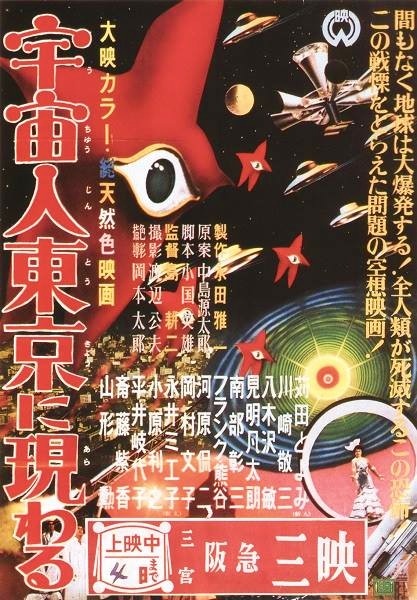
Soon, the Earth will explode: a terror which will annihilate all of humanity! (間もなく地球は大爆発する!全人類が死滅するこの恐怖!)
A science-fiction film about the issues which have encapsulated this horror! (この戦慄をとらえた問題の空想科学映画!) |
„
|
— Tagline |
“
|
Secret Agent: Seductive android woman... Mission: Warn Earth of Planet X's time table for its bloody conquest!
|
„
|
— American tagline |
Warning from Space (宇宙人東京に現わる Uchūjin Tōkyō ni Arawaru, lit. "Spacemen Appear in Tokyo") is a 1956 tokusatsu science-fiction film directed by Koji Shima and written by Hideo Oguni from a story by Gentaro Nakajima, with special effects by Toru Matoba and Yonesaburo Tsukiji. Produced by Daiei Tokyo Studio, it stars Keizo Kawasaki, Toyomi Karita, Bin Yagisawa, Isao Yamagata, Shozo Nanbu, Bontaro Miake, Mieko Nagai, and Kiyoko Hirai. It was released to Japanese theaters by Daiei on January 27, 1956, becoming the country's first science-fiction film in color.
Plot
Flying saucers are seen over the skies of Tokyo. A journalist asks Dr. Komura for a statement on the flying saucers, but Komura simply says that they do not have enough evidence to formulate a hypothesis. Meanwhile, in an observatory, Professor Isobe looks in his telescope and spots an unusual object releasing some objects.
Isobe and Komura later talk about Isobe's discovery. A physician, Dr. Matsuda, gets the idea of taking pictures via a rocket. However, the pictures they take appear to be unclear. They then deduce the object has high energy output. Meanwhile, the Pairans have been unsuccessfully attempting to contact the humans. A small Pairan ship travels and connects to a bigger one. In it, the Pairans discuss how to warn the humans of the incoming threat they have just discovered. They start appearing in buildings, rivers, and lakes, scaring the citizens of Japan. A Pairan manages to get a photo of Hikari Aozora, a popular Japanese entertainer. The plan is for a Pairan to mutate into the form of Hikari Aozora. A Pairan leader, Ginko, volunteers herself. She gets in a circular device and slowly starts to mutate into a human form.
Sometime later, Isobe's son, Toru, finds Ginko in the water. Sometime after she is rescued, she starts showing superhuman abilities such as jumping 10 feet high and appearing in different places without making any sound. She was also shown to completely understand Matsuda's work on a nuclear device, leading him to doubt she is actually a human. Later, as scientists discuss her superhuman abilities and the ability to understand how a nuclear device works, Ginko levitates towards them and reveals her true identity. She explains to them that she is from the planet Paira and tells them that a rogue planet is about to collide with Earth. They appeal to the World Congress about the situation, but are rejected. Not much long afterward, the World Congress considers it real and a threat; they launch nuclear weapons at the rogue planet hoping to destroy it, but the missiles are proven to be ineffective.
Meanwhile, Matsuda is kidnapped by a group of spies who demand his formula for a nuclear device. Matsuda refuses to give it to them, but is then tied to a chair and left in the building. Earth's atmosphere heats up and Ginko comes back to see that Planet R was not destroyed. The Pairans use their technology to locate Matsuda, who was wearing a Pairan ring, and gather the formula. The Pairans then create a nuclear weapon of their own and destroy the rogue planet, saving Earth.
Staff
Staff role on the left, staff member's name on the right.
- Directed by Koji Shima
- Written by Hideo Oguni
- Based on a story by Gentaro Nakajima
- Executive producer Masaichi Nagata
- Music by Seitaro Omori
- Cinematography by Kimio Watanabe
- Edited by Toyo Suzuki
- Production design by Shigeo Mano
- First assistant director Kozo Kanno
- Directors of special effects Toru Matoba; Yonesaburo Tsukiji (uncredited)
- Color design and Pairan design by Taro Okamoto
Cast
Actor's name on the left, character played on the right.
- Keizo Kawasaki as Dr. Toru Isobe
- Toyomi Karita as Hikari Aozora / Ginko Amano
- Bin Yagisawa as Pairan No. 2
- Isao Yamagata as Dr. Eisuke Matsuda
- Shozo Nanbu as Dr. Naotaro Isobe
- Bontaro Miake as Dr. Yoshio Komura
- Mieko Nagai as Taeko Komura
- Kiyoko Hirai as Kiyoko Matsuda
- Fumiko Okamura as Madam Ohana
- Toshiyuki Obara as Kenichi Hideno, reporter
- Shiko Saito as mysterious man
- Sachiko Meguro as Tokuko Isobe
- Frank Kumagai as astronomical observatory correspondent
- Kanji Kawara as Dr. Takashima
- Tetsuya Watanabe as Sankichi
- Akira Natsuki as Pairan No. 3
- Shunji Tsuda as Pairan No. 4
- Gai Harada as sailor
- Seiji Izumi
- Yasuko Hanamura as geisha
- Kenji Tani as bouncer
- Ko Sugita as reporter
- Yuji Hayakawa as policeman
- Noriaki Yuasa as Lake Chuzenji onlooker (uncredited)
Titra Sound Studios English dub
- Jack Curtis as Pairan Leader[3]
- Bret Morison as Dr. Komura[2][3]
- Larry Robinson as Dr. Matsuda / Hideno[3]
- Peter Fernandez[3]
- Corinne Orr[3]
- Arianné Ulmer Cipes[3]
Appearances
Weapons, vehicles, and races
- Pairan
- Urium
- Pairan saucer
- Pairan space station
- Pairan nuclear missile
- Banshiu Maru No. 32
Gallery
- Main article: Warning from Space/Gallery.
Alternate titles
- Spacemen Appear in Tokyo (literal Japanese title)
- Uchujin Tokyo Ni Arawaru (English Japanese Blu-ray title)
- Assault to the Earth (Asalto a la Tierra; Spain)
- The Mysterious Sattelite (Le Satellite Mystérieux; France)
- The Cosmic Man Appears in Tokyo (alternate United States title)
- Unknown Satellite Over Tokyo (alternate United States title)
- Mysterious Satellite (United Kingdom)
Theatrical releases
- Japan - January 27, 1956
- Spain - November 11, 1957; May 16, 1970 (re-release)
- France - November 27, 1957
- United Kingdom - May 1958[4]
- Myanmar - 1958[3]
- Malaysia - 1958[3]
Foreign releases
U.S. release
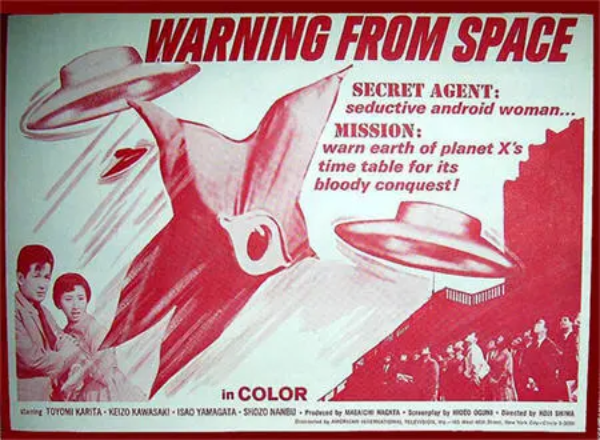
Rather than a theatrical release, Four Star International released Warning from Space directly to American television in the summer of 1963, as part of its "Spectacular Showcase" syndication package.[1] The English version was produced by Jay Cipes and Edward Palmer, under their company Cipes & Palmer, with a dub recorded in New York by Titra Sound Studios.[3] In 1968, the film was rereleased by American International Television as part of its "Fantastic Science Fiction Theater" syndication package.[2]
Several alterations were made in the American version:
- Added: After the opening credits, footage of the Pairan's nuclear weapon heading towards Planet R is played in reverse, giving the illusion of a spaceship docking into the Pairan space station. More footage from later in the Japanese version is placed at the beginning, as the Parians discuss how to warn humanity of the oncoming threat of Planet R. The English version then picks up where the Japanese version begins.
- Deleted: Dr. Eisuke Matsuda, Kiyoko Matsuda, and Taeko Komura all having dinner.
- Altered: Newspaper headlines reporting on the UFO sightings are now in English.
- Altered: The Pairans' unique language is replaced by English. The scenes with the Pairans in their space station are enlarged, mirrored, and occasionally move from side to side in order to hide the Japanese subtitles.
- Altered: Newspaper headlines about Planet R are now in English.
- Added: Before the Japanese end title card appears, footage from Ginko's transformation is reused and played in reverse, showing her revert back to her Pairan form.
United Kingdom release
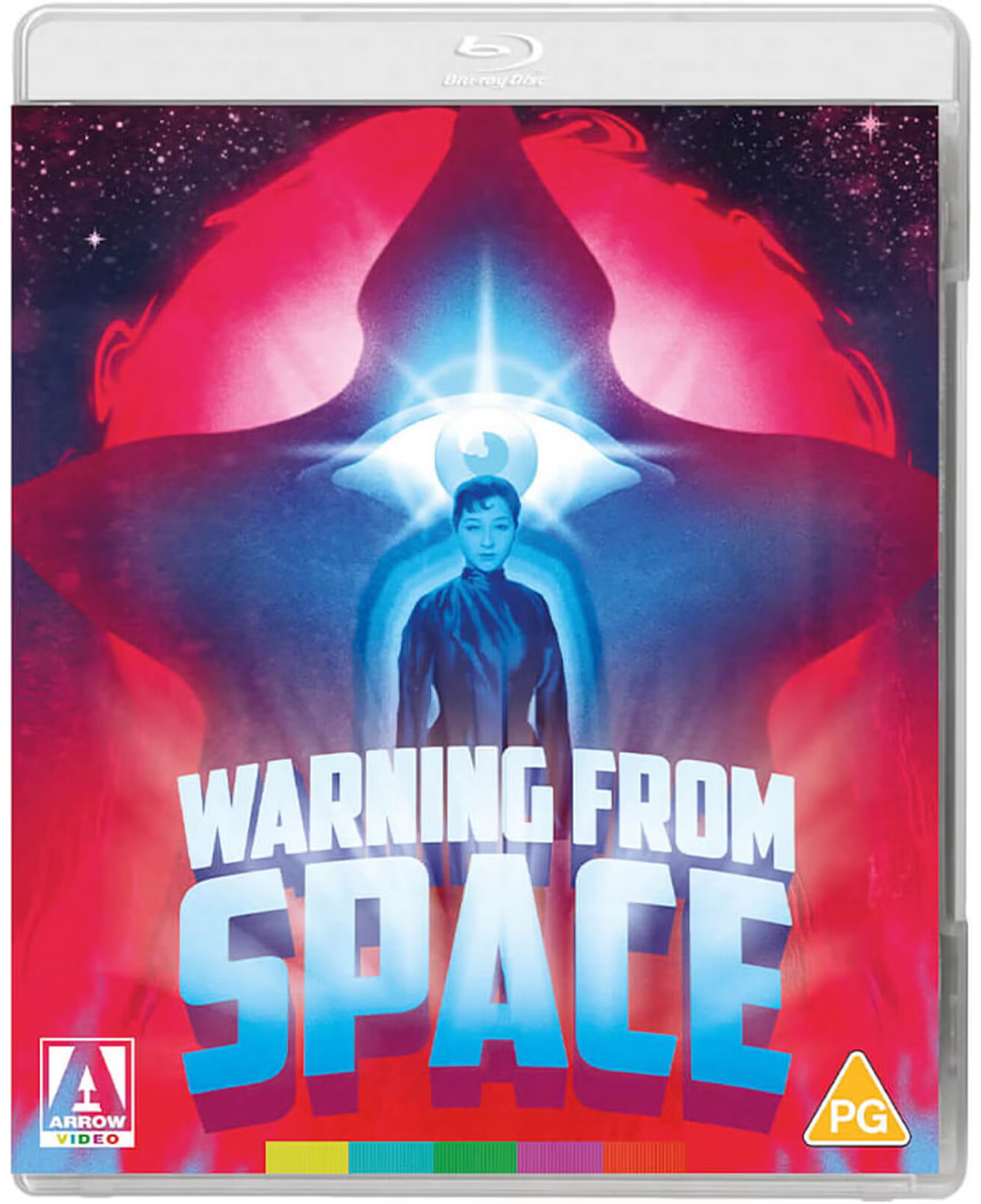
Gala Film Distributors brought an English-subtitled version of Warning from Space to UK theatres in May 1958 as Mysterious Satellite. It was part of a double feature with I Vitelloni (retitled Spivs). The film premiered at the Gala Berkeley Cinema in London and received a U (Universal) rating from the British Board of Film Censors (BBFC) on March 19, 1958.[4][5] Six months later, in November 1958, Gala rereleased the film as Warning from Space, causing the BBFC to classify the film again with the same rating.[6] A review from Monthly Film Bulletin notes that the Japanese subtitles used for when the Pairans speak were still present.[3] Barbican Cinema showed Warning from Space on August 20, 2017.[7] On October 12, 2020, Arrow Video released the Japanese version of Warning from Space on Blu-ray, including the American version as a bonus feature. The BBFC reclassified the film as PG for "mild threat, language".[6]
Video releases
Kadokawa DVD (October 26, 2012)[8]
- Region: 2
- Discs: 1
- Audio: Japanese
- Subtitles: Unknown
- Special features: Unknown
Kadokawa Blu-ray + DVD (2019)
- Region: A
- Discs: 2
- Audio: Japanese
- Subtitles: Japanese
- Special features: Trailer, reprinted press sheet
- Notes: Packaged with a DVD of Tokyo Tower at Twilight.
Arrow Video Blu-ray (October 12, 2020)
- Region: A or B
- Discs: 1
- Audio: Japanese, English (both LPCM Mono)
- Subtitles: English
- Special features: Booklet containing essays on Taro Okamoto by Nick West and the English dub by David Cairns (first pressing only), audio commentary by Stuart Galbraith IV, teaser and theatrical trailer, image gallery
Unlicensed DVDs of the English-dubbed version of Warning from Space proliferated in the United States for years, as the film was presumed to be in the public domain. Among the various home video companies behind these releases were Alpha Video, Sinister Cinema, Digiview Entertainment, Miracle Pictures, and AFA Entertainment.
Videos
|
Trivia
- Despite being benevolent, roughly-human-sized characters in the film, the Pairans are depicted as giant rampaging monsters in some theatrical release posters and stills for the film.
- Ginko Amano describes urium as element 101; the real element 101, mendelevium, had been discovered just one year prior to the film's release.
References
This is a list of references for Warning from Space. These citations are used to identify the reliable sources on which this article is based. These references appear inside articles in the form of superscript numbers, which look like this: [1]
|
|
| ||
Comments
Showing 21 comments. When commenting, please remain respectful of other users, stay on topic, and avoid role-playing and excessive punctuation. Comments which violate these guidelines may be removed by administrators.

|

|

|