

The Three Treasures (1959)



| |||||||||||||||||||||||||||||||||||||||||||||||||||||||||||||||||||||||||||||||||||||||||


“
|
Another major achievement of extraordinary power and beauty by the special effects genius, Eiji Tsuburaya
The Greatest of Toho's Great Films of Special Effects Photography. A Spectacular Epic of the Love and Battles of Prince Yamato, A Legendary Hero of Old Japan. |
„
|
— International taglines |
The Three Treasures (日本誕生 Nippon[a] Tanjō, lit. "The Birth of Japan") is a 1959 tokusatsu epic historical fantasy film directed by Hiroshi Inagaki and written by Toshio Yasumi and Ryuzo Kikushima, with special effects by Eiji Tsuburaya. Produced by Toho, it is based on the legends Kojiki and Nihon Shoki and was promoted as the studio's 1,000th film. It stars an ensemble cast including Toshiro Mifune, Yoko Tsukasa, Akihiko Hirata, Kyoko Kagawa, Takashi Shimura, Setsuko Hara, Kumi Mizuno, Misa Uehara, Kinuyo Tanaka, Akira Kubo, and Akira Takarada. The film was released to Japanese theaters by Toho on November 1, 1959.[5] Toho International released a shortened English-subtitled version of the film to American theaters on December 20, 1960.
Plot
An old lady explains to the townsfolk how the gods appeared and how Japan came to be, and how two gods invented marriage. Prince Osu then arrived home in this town, and heard a rumor that his older brother, the current heir, had taken a girl who was supposed to be in the Emperors’ house. He became upset at this, and fought his brother. He defeated his brother, almost killing him, but ultimately decided to let him go. He told his brother to leave and never come back. The Emperor believed his eldest son to be dead, and this greatly upset him. One of his advisors saw it as a good opportunity to move forward with his plan of putting one of his nephews in power, so he advised the Emperor to execute Prince Osu, but the Emperor instead sent Osu off to kill two brothers who had been terrorizing a nearby town. Before leaving, Osu began a romantic interaction with Princess Ototachibana, who had devoted herself to the gods. Osu headed out with his small group and killed the two brothers, but not before the younger one acknowledged his greatness and gave him the name Yamato Takeru, which means "the Bravest of Yamato."
Afterwards Yamato returned home, but his father sent him off to the east on another mission, as the advisor wished Yamato to die. Back in the town, the old lady from earlier told another story of how the sun goddess Amaterasu went into a cave due to a prank by her brother Susanoo, and how it caused the world to become dark. She went on to tell how the other gods threw a laughter festival and drew her out, bringing the light back into the world. Just before leaving, Yamato, who was grieving due to him thinking his father wants him dead, visited his aunt, who gave him the mythical sword, Kusanagi no Tsurugi, and said that his father wanted him to have it.
Yamato went to his men and told them the story of how Kusanagi no Tsurugi came to be, saying that the god Susanoo went to a house he had found upriver, and had found two old people and their daughter weeping. He discovered that they had originally had eight daughters and had been forced to sacrifice them every year to the serpent Yamata no Orochi, and that the time for him to appear to take their last daughter was coming soon. Susanoo declared that he wouldn’t let that happen, and transformed the daughter into a comb and set up eight large jugs of sake for the monster to drink. The monster appeared, as was expected, and it drank the sake, and passed out drunk. Susanoo went to the monster and went to attack it as it slept, but it awoke, forcing Susanoo to cause the serpent to weave its heads through the bushes and become stuck. Susanoo then went to the backside of the monster, and plunged his sword repeatedly into the tail of the beast. He then reached inside one of the wounds he had made, and pulled out the Kusanagi no Tsurugi. Yamato finished the story, and took his men to the east as per his father’s orders. Just before leaving, however, Princess Tachibana approached him and told him that she hated him, though in reality she was forbidden from loving anyone due to her oath to the gods.
Yamato and his army headed east, with them first finding a village in which Princess Miyazu attempted to kill him, but decided not to and then fell in love with Yamato. Yamato then later found a village whose leader tried to kill him, as the advisor’s men went ahead to tell him to kill Yamato. Yamato found that his father had been the one to tell the leader to kill him, which troubled his heart. Princess Tachibana followed Yamato here, and declared that she does love him. This upset the gods, however, and they plagued Yamato and his army with great storms. Tachibana then jumped in the water, killing herself, in order to appease the gods, which worked. Yamato then decided to head back home and confront his father.
He arrived near home, though the advisor had sent a large army out in order to kill Yamato. After he fought against them with his army, he ended up being killed and transformed into a bird. As a bird, he caused a volcanic eruption and flooding which resulted in the deaths of all the members of the army which had tried to kill him.
Staff
- Main article: The Three Treasures/Credits.
Staff role on the left, staff member's name on the right.
- Directed by Hiroshi Inagaki
- Written by Toshio Yasumi, Ryuzo Kikushima
- Executive producers Sanezumi Fujimoto, Tomoyuki Tanaka
- Music by Akira Ifukube
- Cinematography by Kazuo Yamada
- Edited by Kazuji Taira
- Production design by Kisaku Ito, Hiroshi Ueda
- First assistant director Teruo Maru
- Director of special effects Eiji Tsuburaya
Cast
Actor's name on the left, character played on the right.
- Toshiro Mifune as Prince Yamato Takeru / Susanoo
- Yoko Tsukasa as Princess Ototachibana
- Kumi Mizuno as Azami
- Misa Uehara as Princess Kushinada
- Kyoko Kagawa as Princess Miyazu
- Kinuyo Tanaka as Princess Yamato
- Nobuko Otowa as Ame no Uzume
- Haruko Sugimura as elderly storyteller
- Akira Takarada as Prince Wakatarashihiko
- Akira Kubo as Prince Ioki no Iribiko
- Ganjiro Nakamura II as Emperor Keiko
- Eijiro Tono as Otomo no Takehi Muraji
- Akihiko Hirata as Kibi no Takehiko
- Ko Mishima as Yakumo
- Hisaya Ito as Otomo no Kodate
- Jun Tazaki as Otomo no Kurohiko
- Takashi Shimura as Kumaso no Ken (elder brother)
- Kichijiro Ueda as Kume no Yahara
- Yoshio Kosugi as Inaba
- Kozo Nomura as Otomo no Makeri
- Yu Fujiki as Okabi
- Michiyo Tamaki as Ehime
- Keiko Muramatsu as Izanami, goddess
- Kakuko Murata as Okabi's mother
- Chieko Nakakita as Tenazuchi
- Bokuzen Hidari as Ame no Minakanushi, god
- Minosuke Yamada as Owari no Kuni no Miyatsuko
- Junichiro Mukai as Moroto
- Hajime Izu as Prince Ousu
- Akira Sera as Ashinazuchi
- Hiroyuki Wakita as Izanagi, god
- Yoshibumi Tajima, Fuyuki Murakami, Akira Tani as gods in Takamagahara
- Ikio Sawamura as Yaoyorozu no Kami
- Senkichi Omura as father
- Yutaka Sada, Fumindo Matsuo, Jiro Kumagai, Tadashi Okabe, Koji Kamimura, Yasuhiro Shigenobu as Yamato citizens
- Ryu Kuze, Goro Sakurai, Mitsuo Tsuda, Nadao Kirino, Shin Otomo, Shiro Tsuchiya, Haruya Sakamoto, Rinsaku Ogata, Koji Iwamoto, Izumi Akimoto, Hiroyoshi Yamaguchi, Akira Kitano, Akira Yamada as Yamato soldiers
- Yasuhisa Tsutsumi, Masao Masuda as Yamato soldiers from Izumo
- Hideyo Amamoto, Katsumi Tezuka, Masayoshi Nagashima as Otomo-clan soldiers
- Shoichi Hirose as Kumaso-clan soldier
- Yoshiko Ieda, Midori Kishida as village girls
- Michiko Kawa, Misako Asuka as Yamato girls
- Toshiko Higuchi, Akemi Ueno as Kumaso girls
- Teruko Mita as Princess Miyazu's maid
- Koji Tsuruta as Kumaso no Ken (younger brother)
- Daisuke Kato as Futodama
- Taro Asashio III as Tajikarao
- Norihei Miki as Ame no Koyane
- Ichiro Arishima as Ishikoridome
- Kingoro Yanagiya as Omoikane, god
- Kenichi Enomoto as Tamanooya
- Keiju Kobayashi as Amatsumara
- Setsuko Hara as Amaterasu, sun goddess
Appearances
Monsters |
Weapons, vehicles, and races
|
Gallery
- Main article: The Three Treasures/Gallery.
Soundtrack
- Main article: The Three Treasures/Soundtrack.
Alternate titles
- The Birth of Japan (literal translation)
- Age of the Gods (alternate international title)
- The Age of the Gods (A Idade dos Deuses: Brazil)
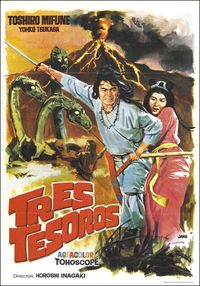
- Three Treasures (Tres Tesoros: Spain)
Theatrical releases
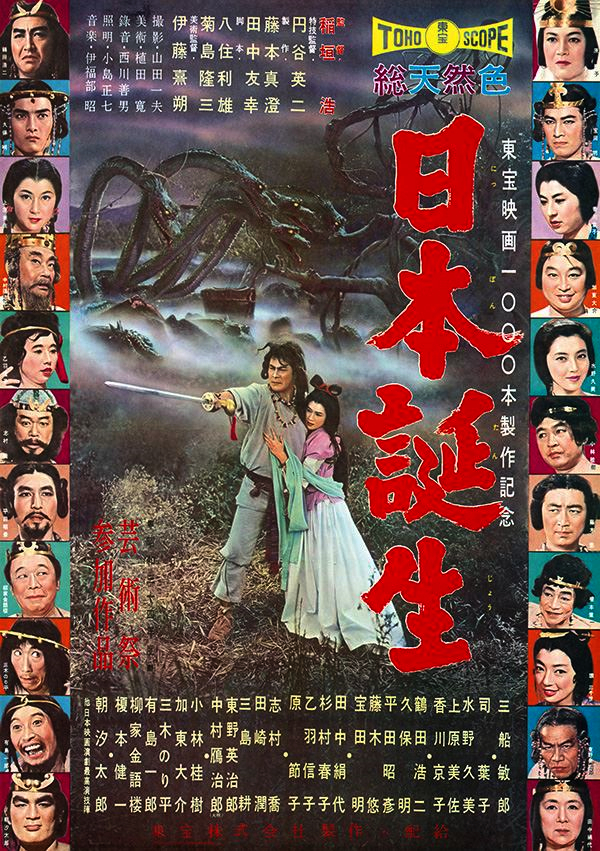
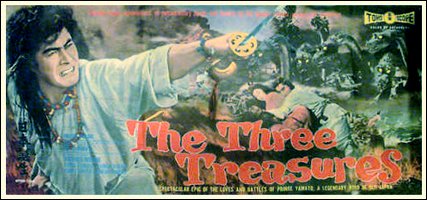
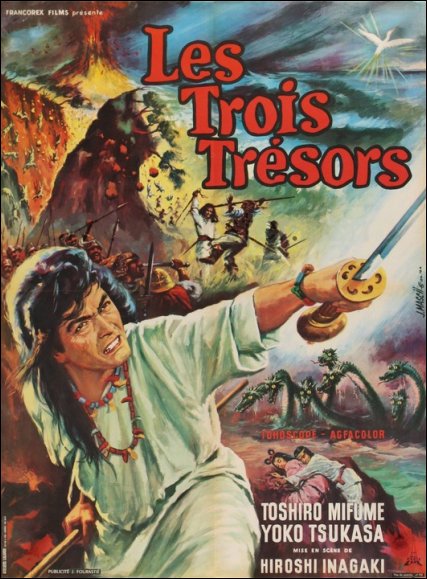
- Japan - November 1, 1959 [view poster]
- United States - December 20, 1960 [view poster]
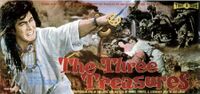
- Portugal - April 5, 1962[6]
- Spain - 1972 [view poster]
- France [view poster]

Foreign releases
U.S. release
The Three Treasures was released theatrically in the United States by Toho International on December 20, 1960. The film's runtime was cut down from 182 minutes to 112 minutes, and it was given English subtitles.[5]
Box office
The Three Treasures grossed ¥344,232,000 in Japan.[2] It was Toho's highest earner in 1959, and second among Japanese films overall.[5]
Video releases
Toho Video VHS (1991)
- Tapes: 2
- Audio: Japanese
DVD Toho DVD (2001)
- Region: 2
- Discs: 1
- Audio: Japanese (Mono)
- Subtitles: Japanese
- Special features: Theatrical trailer, isolated score, music and effects track (from shortened export version), talent files, promotional gallery, export version pamphlet
- Notes: Since its initial release on February 21, 2001, the DVD has been reissued three times: on February 23, 2007, on February 7, 2014, and on July 15, 2015.
TOHO Visual Entertainment Blu-ray (August 20, 2025)[7]
- Region: A
- Discs: 1
- Audio: Japanese (Mono)
- Subtitles: Japanese
- Special features: Trailer, making-of, isolated score, music and effects track, "The Three Treasures: A Pictoral Sketch", "The Three Treasures: A Publicity Mission", still gallery
Videos
|
Trivia
- The Three Treasures is Toho's longest film featuring a kaiju, with a runtime of just over three hours. Because of this, the film contains an intermission 76 minutes into its runtime.
- In 1994, The Three Treasures was loosely remade by Toho Pictures as Orochi, the Eight-Headed Dragon. It, too, features Yamata no Orochi among its special effects sequences, which were directed by Koichi Kawakita.
Notes
References
This is a list of references for The Three Treasures. These citations are used to identify the reliable sources on which this article is based. These references appear inside articles in the form of superscript numbers, which look like this: [1]
|
|
| ||
Comments
Showing 10 comments. When commenting, please remain respectful of other users, stay on topic, and avoid role-playing and excessive punctuation. Comments which violate these guidelines may be removed by administrators.

|

|

|

|

|