

Gamera Super Monster (1980)
| Gamera films | |||||||
|
|
| |||||
| |||||||||||||||||||||||||||||||||||||||||||||||||||||||||||||||||||||||||||||||||||


“
|
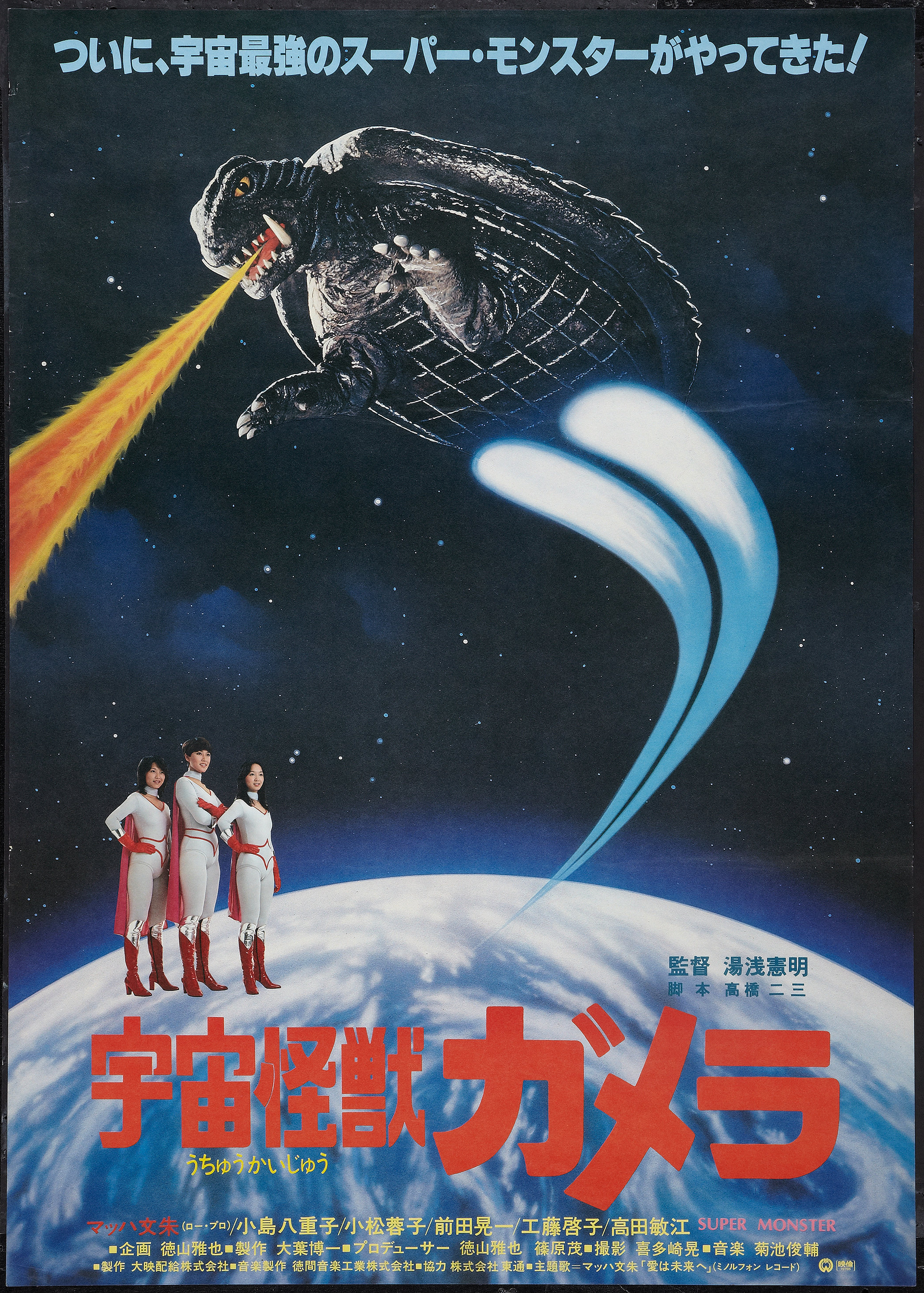
The universe's strongest Super Monster has finally arrived! (ついに、宇宙最強のスーパー・モンスターがやってきた!)
|
„
|
— Japanese tagline |
“
|
The strongest in the universe! Gamera returns again!
Entertaining! Spectacular! A fantasy of space! |
„
|
— International tagline[3] |
“
|
The most riveting film in the history of motion pictures!
|
„
|
— International tagline (trailer) |
Gamera Super Monster (宇宙怪獣ガメラ Uchū Kaijū Gamera, lit. "Space Monster Gamera") is a 1980 tokusatsu kaiju film directed by Noriaki Yuasa (including special effects) and written by Nisan Takahashi. Produced and distributed by Daiei Film Releasing, it is the eighth entry in the Gamera series and final entry in its Showa series, the first Gamera film to be produced by Daiei Film, and the last feature-length Gamera film made by Yuasa or Takahashi. It stars Mach Fumiake, Yaeko Kojima, Yoko Komatsu, Keiko Kudo, and Koichi Maeda. The film was released to Japanese theaters on March 20, 1980, and aired on television in the United States later that year. It also received an English-dubbed theatrical release in Australia under its international title, Super Monster.
Gamera Super Monster features special effects scenes consisting almost entirely of stock footage from the seven previous Showa Gamera films, with the only new footage consisting of shots of Gamera in flight and of his legs while walking. Young Keiichi befriends three extraterrestrial superheroines called the Spacewomen, who learn that the evil captain and crew of the pirate spaceship Zanon intends to attack Earth using the giant monsters Gyaos, Zigra, Viras, Jiger, Guiron, and Barugon. Fortunately, Gamera rises to battle the Zanon's monster pawns, while Keiichi and the Spacewomen contend with the Zanon's agent on Earth, Giruge. Following the film's release, the Gamera series went on hiatus for 15 years until its 30th anniversary in 1995, when it was rebooted with Gamera the Guardian of the Universe.
Plot

When the pirate spaceship Zanon makes its way to Earth to destroy it, all hope seems lost. The Earth's resident superheroes, the Spacewomen, are powerless to stop the ship, its captain and its army of monsters. They must enlist the help of a young boy who has a special connection with Gamera. The friend of all children then fights and kills Gyaos, Zigra, Viras, Jiger, Guiron, and Barugon. He then sacrifices himself to destroy the Zanon.
Staff
- Main article: Gamera Super Monster/Credits.
Staff role on the left, staff member's name on the right.
- Directed by Noriaki Yuasa
- Written by Nisan Takahashi
- Planned by Masaya Tokuyama
- Executive producer Hirozaki Oba
- Produced by Masaya Tokuyama, Shigeru Shinohara
- Music by Shunsuke Kikuchi
- Cinematography by Akira Kitazaki
- Edited by Tamotsu Taga
- Production design by Tsuneo Yokojima
- First assistant director Hirochika Muraishi
Cast
Actor's name on the left, character played on the right.
- Mach Fumiake as Kilara
- Yaeko Kojima as Marsha
- Yoko Komatsu as Mitan
- Keiko Kudo as Giruge
- Koichi Maeda as Keiichi
- Toshie Takada as Keiichi's mother
- Hiroji Hayashi as delinquent A
- Tetsuaki Toyosumi as delinquent B
- Hideaki Kobayashi as delinquent C
- Makoto Ikeda as Keiichi's friend
- Kisao Tobita as driver
- Yasuhiro Saito as news announcer
- Bunraku Katsura IX as Officer Ryotsu (as Komasu Katsura)
- Osamu Kobayashi as captain of the Zanon (voice)
- Tadashi Nakamura as narrator (voice)
Axis International English dub
- Suzanne Vale as Kilara / Giruge / Keiichi's mother (all unconfirmed)[b]
- Carolyn Levine as Marsha / Mitan / Keiichi
- Chris Hilton as driver / news announcer / captain of the Zanon / punk / reporter
- Ted Thomas as Officer Ryotsu / narrator / photographer
Appearances
Monsters |
Weapons, vehicles, and races
|
Alternate titles
- Space Monster Gamera (literal Japanese title)
- Super Monster (original English title, Australian title)
- Gamera: The Super Monster (original U.S. DVD title)
- Gamera: Super Monster (U.S. DVD title)
- Gameka: Unidentified Flying Object (Gameka - Objet volant non identifié: France)
- Gameka and the Three Super Women (Gameka et les Trois Super Women: French video title)
- Phoenix Dominator - Mission: Invade the Earth (Phoenix Dominator - Mission: Invasion terre: French video title)
Theatrical releases
Foreign releases
U.S. release
Gamera Super Monster was released to television syndication by Filmways Pictures in 1982, adding the monster's name to Daiei Film's original English Super Monster title. Instead of producing its own English dub, Filmways used Daiei's pre-existing dub recorded in Hong Kong by Ted Thomas' group. The film has since been released on DVD by Shout! Factory in 2011, as well as on Blu-ray by Mill Creek Entertainment and Arrow Video in 2014 and 2020 respectively.
United Kingdom release
Arrow Video released the original Japanese version of Gamera Super Monster, along with the English dub, for the first time in the UK as part of its Gamera: The Complete Collection Blu-ray box set on August 17, 2020. Arrow would rerelease the disc in the Gamera: The Showa Era Blu-ray set on January 25, 2021. The British Board of Film Classification (BBFC) classified the film PG for "mild fantasy violence, threat".[1]
Gallery
- Main article: Gamera Super Monster/Gallery.
Video releases
Shout! Factory DVD (March 15, 2011)
- Region: 1
- Discs: 1
- Audio: Japanese (1.0 Mono), English (1.0 Mono)
- Special features: Photo galleries
- Notes: Both versions of the film use the same Japanese video track. The audio source for the film's English dub is of low fidelity and is missing the line "The Chilling Monster Barugon is attacking the city of Osaka, having destroyed the city of Kobe." Packaged with Gamera vs. Zigra.
Mill Creek DVD (2014) [Gamera: The Legacy Collection]
- Region: 1
- Discs: 4
- Audio: Japanese (1.0 Mono)
- Special features: None
- Notes: Packaged with Gamera the Giant Monster, Gamera vs. Barugon, Gamera vs. Gyaos, Gamera vs. Viras, Gamera vs. Guiron, Gamera vs. Jiger, Gamera vs. Zigra, Gamera the Guardian of the Universe, Gamera 2: Attack of Legion, and Gamera 3: Revenge of Iris.
Mill Creek Blu-ray (2014) [Gamera: The Ultimate Collection Volume 2]
- Region: N/A
- Discs: 2
- Audio: Japanese (Dolby Digital 2.0)
- Special features: None
- Notes: Packaged with Gamera vs. Guiron, Gamera vs. Jiger, and Gamera vs. Zigra.
Arrow Video Blu-ray (2020/2021) [Gamera: The Complete Collection and Gamera: The Showa Era]
- Region: A and B
- Discs: 8 (The Complete Collection) or 4 (The Showa Era)
- Audio: Japanese and English (DTS-HD Master Audio Mono)
- Subtitles: English
- Special features: Audio commentary by Richard Pusateri, introduction by August Ragone (6 minutes), opening and end credits from the international and Filmways versions of the film (11 minutes), Japanese and international trailers, and an image gallery. Gamera: The Complete Collection includes 12 art cards by Matt Frank, a map of Gamera's appearances throughout the world, and two books; the first collects A History of Gamera by Patrick Macias, a 1996 Noriaki Yuasa interview by David Milner, kaiju x-ray illustrations by Jolyan Yates, three Fangoria articles on the Heisei Gamera trilogy by Norman England, a guide to the English dubs of the Gamera series by James Flower, and information on the transfers presented in the set, while the second reprints the comics Gamera and The Last Hope.
- Notes: Gamera: The Complete Collection is out of print. Packaged with the other 11 Gamera films in The Complete Collection and the other seven Showa Gamera films in The Showa Era. Due to the large number of special features in these sets, only the supplements pertinent to Gamera Super Monster are described above.
Videos
Trailers
|
Miscellaneous
|
Trivia
- Though Gamera is killed at the end of this film, he is resurrected using an artificial sun in the 1994-95 manga Gamera the Giant Monster.[4]
- Every one of the monsters fought by Gamera in the Showa series appears in this film via stock footage from each of the films that they first appeared in, with each beginning with a subtitle revealing their name. Gamera fights Gyaos, Zigra, Viras, Jiger, Guiron, and Barugon, in that order.
- Actress Mach Fumiake, who portrays the Spacewoman Kilara, was a professional wrestler at the time this film was made.
- The "Gamera March" is absent from this film, with a new theme song, "Love for Future," being used instead.
- Due to the heavy use of stock footage, this film features only about two minutes of new Gamera footage.
- The film features a spaceship which bears a suspicious resemblance to an Imperial Star Destroyer, an obvious attempt on Daiei's part to capitalize on the success of the Star Wars saga. The second film in the series, Star Wars Episode V: The Empire Strikes Back, opened in Japan four months later.
- As Gamera originally fought Guiron on an alien planet (i.e., Terra), a plot device was created for this film that allowed Gamera to travel to his enemies' locations.
- At one point in the film, Gamera knocks over a standing poster while destroying Tokyo under the spaceship Zanon's control. The camera then zooms closer, revealing it to be for a film titled "Farewell, Dodzilla" (さらばドジラ Saraba Dojira), featuring artwork strongly resembling Godzilla, Gamera's box-office rival. While the Godzilla series was in the middle of a lengthy hiatus at the time, Toho re-released Mothra vs. Godzilla (1964) to theaters just five days before Gamera Super Monster opened.
- One scene in the film shows Gamera flying with the Yamato from the anime Space Battleship Yamato and another one shows Gamera chasing the Galaxy Express 999 from the titular anime, both of which combine live-action footage of Gamera with animation.
- Daiei contracted Ex Productions to create new Gamera suits and props for this film, as the previously-existing ones had all been destroyed in a studio fire after Daiei went bankrupt in 1971. Ex created a Gamera suit and a Gamera prop for the film, though Daiei ultimately decided to primarily use stock footage from the seven previous films, relegating the prop to a few brief flying scenes and the suit to a single shot of its lower body.
Notes
- ↑ The film's theater program estimates that production would have cost ¥1 billion if done from scratch, but by using stock footage from prior movies, the budget was reduced to "1/5th of that."[2]
- ↑ Suzanne Vale's voice has never been definitively identified; however, circumstantial evidence links her to the actress who voiced Kilara, Giruge and Keiichi's mother in this dub.
References
This is a list of references for Gamera Super Monster. These citations are used to identify the reliable sources on which this article is based. These references appear inside articles in the form of superscript numbers, which look like this: [1]
|
|
| ||
Comments
Showing 157 comments. When commenting, please remain respectful of other users, stay on topic, and avoid role-playing and excessive punctuation. Comments which violate these guidelines may be removed by administrators. Loading comments...
|

|

|

|

|

|

|

|

|

|

|