

Konga (1961)



| |||||||||||||||||||||||||||||||||||||||||||||||||||||||||||||||||||||||


“
|
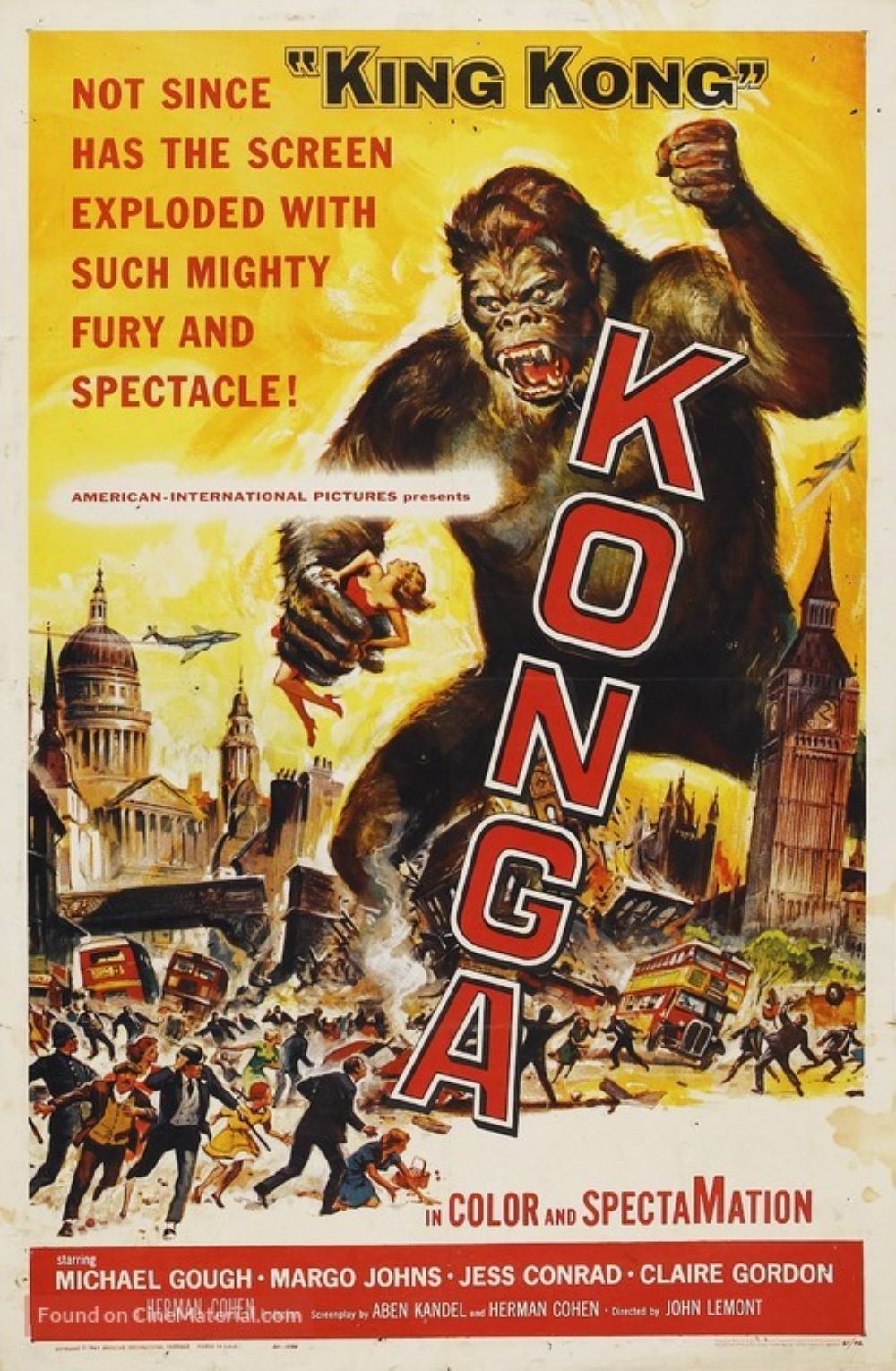
Not since "King Kong" has the screen exploded with such mighty fury and spectacle!
|
„
|
— Tagline |
|
This page is a sandbox. Sandboxed pages are unfinished and not yet approved. Information found here may be unpolished or unverified. |
|---|
Konga is a British science fiction monster film produced by Anglo-Amalgamated Productions. It was released to British theaters on March 26, 1961 and to American theaters on May 3 of the same year by an International Pictures as a double feature with Master of the World.
Plot
A journalist states that Charles Decker had a plane accident during a trip to Africa, surviving in Uganda after jumping from the plane and being helped by a tribe, the Bagandas. He spent one year there and returned with a monkey named "Konga" and several carnivorous plants.
When he arrived home, after an interview, he began talking with Dean Foste. Charles Decker told her about his secret plan to dominate the world with Godsell, but he became offended when Margaret questioned him. After that, he went outside to pick some flowers, which he planned to use as fertilizer for new ones, and later both went to rest.
Soon after, Charles Decker used a root from a Ugandan plant for research in his laboratory, discovering that it could increase growth. He boiled it to make it liquid. A little later, Margaret entered to see him but did not close the door, letting her cat in; the cat drank the liquid. To prevent accidents, Charles shot the cat. Then he planted the success of Herman Coh, which were fed with pieces of meat. He took one of the leaves to examine it with a syringe, and the syringe was injected into Museum]]'. Afterward, en (who w was locked in his cage, and after a few seconds, the ape doubled in size.
Charles gave his students a kind of presentation about the Bagandas tribe, and one of his students, Sandra, offered to help him. After that, the director of the place called him, upset that he had talked about his strange experiment, trying to force him to rest and stop working.
At home, Konga brought coffee to Margaret, who rewarded him with an apple. Soon after, Charles came to check on them and told Margaret to lock Konga in the cage, then continued scolding her. After she left, Charles injected Konga again, causing him to quadruple in size. Charles hypnotized him, commanding that he always obey him and explicitly ordering him to attack people. Charles then called Margaret.
The director who had fired Charles was organizing some papers but was strangled by Konga, which appeared in the news as “University Director Killed by a Mysterious Assassin.” A detective immediately realized that such strength could only come from an animal.
Margaret quickly deduced that it was Charles and confronted him. But Charles defended himself, saying that she had helped him and was also responsible for everything that involved them, including the crime.
The detective interviewed Margaret’s mother, and later Charles, who explained that during his time in the jungle he had met the Bagandas, Konga, and the carnivorous plants, and showed them to his students.
Meanwhile, Margaret attended a party with Charles. There, he started a conversation with Tagore, who wanted to talk about what he had seen in Africa. The man said he had also done experiments with some carnivorous plants and was fascinated. Charles proposed they join forces for a common goal, and the man gave him his home address.
At home, Charles said goodbye to Margaret before going to Tagore’s house. When he arrived, he knocked on the door, and as expected, he was welcomed in, and they began talking. However, this was part of Charles’s secret plan to have Konga strangle Tagore. Afterward, Charles and Konga returned home.
The next day, Charles said goodbye to Margaret again as he left for the university, reminding her to feed Konga. After class, Charles went with Sandra and the other students to a forest, where he picked up a fern and explained what roots are.
Charles asked Sandra to help him with something, but when she went to get her lunch, which she had left in the car, another student convinced her to stay away from Charles because they liked each other. Before Charles noticed, they kissed.
When it started to rain, everyone took shelter and danced, and afterward, everyone went back to the truck — except for the boy from before, who got angry and went to argue with Charles about Sandra, even trying to strangle him. Charles told him it was better for both of them to forget it. Bob later invited Charles to dinner but went instead to see the girl he liked, Sandra. However, he was killed by Konga, who was then placed inside Charles’s truck, leaving Bob’s mother in tears.
Another detective discovered that it had to be an animal because it left traces of fur.
Once again, Margaret confronted Charles; Konga had already killed three people, but Charles said he needed to test another experiment. Charles proposed killing Konga so they wouldn’t be discovered and said he would also invite Sandra to dinner.
When she arrived, Charles took her with him to kill Konga, showing her his carnivorous plants in the process. He told Sandra that she had better skills than Margaret. Offended, Margaret hypnotized Konga. Meanwhile, Charles tried to force Sandra to join him, but they ended up kissing.
At the same time, Margaret told Konga that from now on, he would only obey her, no matter what. She injected him with the syringe, and shortly after, Konga tripled in size, breaking through the ceiling and destroying Charles’s laboratory. Margaret screamed in fear, and Konga grabbed her to keep her from being burned as the place caught fire. Then he grew to the size of a building, destroying the entire house and the garden where the carnivorous plants were. Inside, Sandra was eaten by a carnivorous plant, while Charles was seized by Konga. Moments later, Konga left the area, heading toward the city and terrifying anyone in his path.
The chaos forced the military to deploy heavy weaponry—specifically tanks, bazookas, and other arms—ultimately killing to see yo, Charles, and Margaret.
Staff
Staff role on the left, staff member's name on the right.
- Directed by John Lemont
- Written by Herman Cohen, Aben Kandel
- Produced by Herman Cohen, Nathan Cohen, Stuart Levy
- Music by Gerard Schurmann
- Cinematography by Desmond Dickinson
- Edited by Jack Slade
Cast
Actor's name on the left, character played on the right.
- Michael Gough as Dr. Charles Decker
- Margo Johns as Margaret
- Jess Conrad as Bob Kenton
- Claire Gordon as Sandra Banks
- Austin Trevor as Dean Foster
- Jack Watson as Superintendent Brown
- George Pastell as Professor Tagore
- Vanda Godsell as Bob's mother
- Stanley Morgan as Inspector Lawson
- Grace Arnold as Miss Barnesdell
- Leonard Sachs as Bob's father
- Nicholas Bennett as Daniel
- Kim Tracy as Mary
- Rupert Osborne as Eric Kenton
- Waveney Lee as Janet Kenton
- John Welsh as Commissioner Garland
- Paul Stockman as Konga (uncredited)
Appearances
Monsters |
Weapons, vehicles, and races
|
Development
After the success of Herman Cohen's previous British-made film that also starred Michael Gough, Horrors of the Black Museum, Nathan Cohen (who was no relation to Herman Cohen) of Anglo-Amalgamated Productions approached and asked Herman Cohen to make another exploitation film. As Cohen had admired the film King Kong for a long time, he thought of a film about a giant ape shot in color. Due to the success of Herman Cohen and American International Pictures' past film I Was a Teenage Werewolf, the film was originally pitched as I Was a Teenage Gorilla, which was also its working title.[1] Cohen also brought in British director John Lemont. Cohen then paid RKO Pictures a total amount of $25,000 for the name of King Kong so he could use it for exploitation purposes. Anglo-Amalgamated and American International Pictures each provided half of the funding for the US$500,000 film, with each studio receiving distribution rights in their respective hemispheres.
Production
The film was shot at Merton Park Studios, a British film production studio that was located in Merton Park, South London.
The scene in the film where Konga grows to giant size, destroys Decker's manor and breaks through the glass sealing of his greenhouse was done using a built set, but when Konga treks throughout London, because of the tight budget it was accomplished with traveling mattes, an effective but difficult process that dragged on long after principal photography ended. "It took over a year and a half to get those bloody special effects done perfect," according to Cohen; Cohen also said "Konga was in color and that's a whole different bag of beans. To have Konga hold Michael Gough, what I had to do there was matte five different scenes on one frame." When Konga holds people, the people were replaced with dolls. The scene where Konga dies was shot in the Embankment of London; Cohen's production manager warned him that he would never get permission from the police to have them shoot in the streets, but Cohen did just that. They accepted, but because they shot semi-machine guns and bazookas at the sky, more than a few people were startled. In Cohen's words, he said "I had a lot of apologies to make."[1]
The uncredited actor in Konga's suit, Paul Stockman, revealed how he got to be in the gorilla suit in a interview. After introducing himself, he said "How I came to get the part of Konga: my agent told me there was an American producer looking for a six-foot actor. Would I go to Mac’s Rehearsal Rooms, Leicester Square, London? So I toddled along; I walked into the room and there’s 20 six-foot tall blokes! I thought, “Oh, dear, it’s a lineup!” Anyway, the producer Herman Cohen came in carrying a big cardboard box. He said, “The actor I need must be exactly six foot, so if you’re six foot, one or five foot, eleven, thank you for coming but you won’t do.” So everybody left except three, two other guys and myself. The producer then opened a cardboard box and took out the gorilla headpiece. He said, “Now I’d like all three of you to try this on because the guy who gets the part will have to wear this six to eight hours a day, so see how you feel with it.” So, we each put the gorilla head on. The other two had blue eyes and I’ve got brown eyes. And we all knew a gorilla has brown eyes. So that was how I got the part!". He also said "From that, interesting, too, we had an assistant director called Buddy…Buddy was one of those guys, very efficient, he kept pushing me around and said, “Over here! Over there!” And I got fed up with him. And I decided on the last day of filming I was gonna give him one. However, the last day of filming, he wasn’t there. I said, “Where’s Buddy?” And they said, “He’s gone to work on a new film.” So we finished the film and the next day we had the special wrap party. All the actors and crew got together, made a special party, and somebody came and tapped me on the shoulder and said, “Paul, you’re wanted on the phone.” I thought, “What? Who could be phoning me here?” So I picked up the phone, and said, “Hello?” And the voice said, “Hello, Paul, it’s Buddy!” I said, “Buddy?” He said, “Yes!” He said, “Buddy! I don’t know if you know it, but they just started working on a new film, and they need a guy to play the monster, it’s called Dr. Blood’s Coffin. And I told the producer what a lovely, sweet-natured guy you were! And he’s agreed to see you.” And guess what! I got the part. So it shows you, always be nice to everybody. You never know how it’s going to turn out!".[2]
In a 2017 episode of the BBC's TV series The One Show, Jess Conrad revealed that he was scheduled to sing a song for the film, but it was cut.
Gallery
- Main article: Konga (film)/Gallery.
Alternate titles
- Giant Ape Monster Konga (巨大猿怪獣コンガ Kyodaien Kaijū Konga) (Japan)
- King Kong (Spain, Turkey)
Theatrical releases
- United Kingdom - March 26, 1961
- United States - May 3, 1961
- Boston - March 22, 1961
- Portugal - January 3, 1978
Adaptations
A 144-page paperback tie-in novelization of Konga was published by Monarch Books in 1960 and was written by Dudley Dean McGaughy under the pseudonym Dean Owen. Charlton Comics published a 24-issue Konga comic book series from 1961 to 1965. While the first issue was a adaptation of the film itself, subsequent issues would revolve around the adventures of a second Konga who was created after the first one died and various other monsters making appearances. The last issue of the series would be renamed Fantastic Giants and would feature four stories; two of them were reprints of the first issues of both Gorgo and Konga, while the other two were original stories. The series would later be followed up by a three-issue spin-off miniseries published from 1962 to 1964 and titled The Return of Konga (later retitled Konga's Revenge after the first issue).
Video releases
Warner Home Video VHS (1990)
- Tapes: 1
- Audio: English
- Notes: Out of print.
MGM DVD (2005)
- Region: 1
- Discs: 1
- Audio: English (PMC Mono)
- Subtitles: English, French
- Notes: Out of print.
MGM DVD (2007) [Midnite Movies Double Feature]
- Region: 1
- Discs: 1
- Audio: English (Mono and Stereo), Spanish (Mono)
- Subtitles: English, Spanish, French
- Special features: None
- Notes: Packaged as a two-sided disc with Yongary, Monster from the Deep on Side A. Out of print.
Kino Lorber DVD/Blu-ray (2019) [Kino Lorber Studio Classics]
- Region: A
- Discs: 1
- Audio: English (2.0 Mono)
- Subtitles: English
- Special features: Theatrical trailer, radio spot, image gallery, theatrical trailers for A*P*E, Dinosaurus! and The Land Unknown
- Notes: Out of print.
Network Blu-ray (2022)
- Region: B
- Discs: 1
- Audio: English (2.0 Mono)
- Subtitles: English
- Special features: Theatrical trailer, U.S. version's radio spot, image galleries, interview with Jess Conard, eight-page booklet
- Notes: Out of print.
Reception
The film was reviewed in The New York Times, in which film critic Eugene Archer noted that it played to "misplaced guffaws". Archer also stated "... the British 'Konga' is nothing more than an overblown 'King Kong,' hammily played by Michael Gough and an improbable-looking ape."
In a review by time out magazine, Konga was considered to be a "Inept, silly, and ludicrously enjoyable monster movie, with Gough as the mad boffin who injects a chimp with a growth serum, only to see it turn into an unaccredited actor in a gorilla suit. Thereafter the ape grabs a Michael Gough doll and heads for Big Ben. Deeply political."
On the website Rotten Tomatoes the film holds a 33% approval rating, and on IMDB it holds a weighted average of 4/10 stars.
Videos
Trailers
|
Trivia
- The gorilla suit used to portray Konga in the film belonged to George Barrows who wore it for several other films.
- The German import DVD release of the film has a Super 8 version of the film (German language only) as a bonus feature.
- When Dr. Decker is showing his films of his adventures in Africa, many of the stock footage sequences actually come from footage taken of the inhabitants of Papua New Guinea or the nearby islands.
- When Konga arrives at Big Ben, the time shows about 11:38 PM. However, in about five minutes film time, Big Ben strikes 12:00 midnight as Konga lies dead by the side of Dr. Decker.
References
This is a list of references for Konga (film). These citations are used to identify the reliable sources on which this article is based. These references appear inside articles in the form of superscript numbers, which look like this: [1]
|
| ||
Comments
Showing 22 comments. When commenting, please remain respectful of other users, stay on topic, and avoid role-playing and excessive punctuation. Comments which violate these guidelines may be removed by administrators.