

F-7J
| ||||||||||||||||||||||||||||||||||||||||||||||||||||||||||
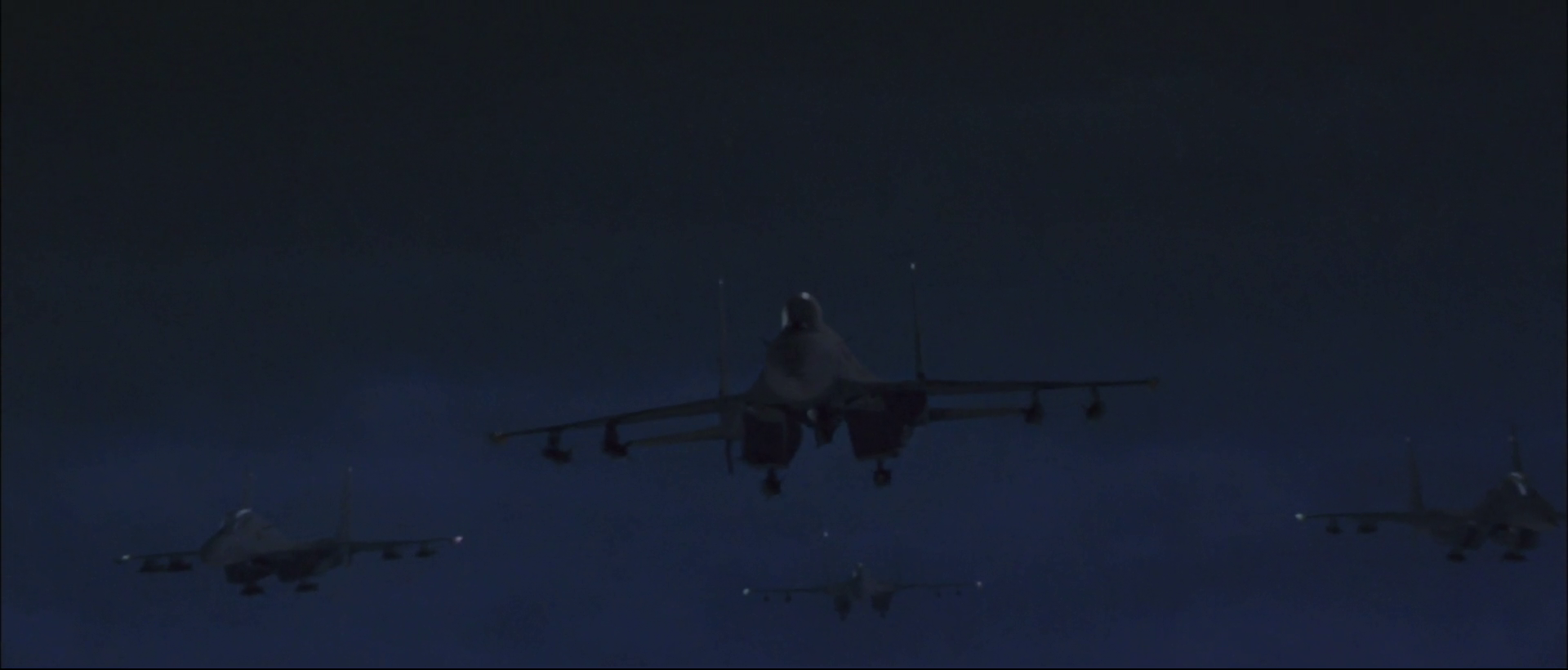
The F-7J is a fictional model of fighter-bomber operated by the Defense Air Force in the 2001 Toho Godzilla film Godzilla, Mothra and King Ghidorah: Giant Monsters All-Out Attack.
Development
The F-7J was drawn up based on a design by the film's art director Takeshi Shimizu.[5] Shimizu stated, "I designed it as a fictional fighter plane, but [special effects director Makoto] Kamiya wanted a real Sukhoi, so that's what we decided on."[6]
A 1/15 scale F-7J miniature was produced using a model of a Su-27 "Flanker", as well as a cockpit. The wreckage of an F-7J destroyed by Godzilla was produced by Japanese special effects modeling studio Beagle. The company's founder, modeler Atsushi Hagiwara, commented, "I think they only made the destroyed parts. The material is FRP resin, which is made by laminating glass fiber."[5] Motor/lieZ, a visual effects division of the Japanese CG production company Image Co., Ltd., created the CGI model of the fighter jet.[7]
Director Shusuke Kaneko originally wrote that all the debris of the F-7Js landed in the surrounding mountains. Makoto Kamiya rewrote the scene so that the rubble of one jet would crash into a home, changing Kaneko's mind. During a budget meeting, one of the housing modelers said, "I don't have Kaneko's consent, so let's cut this out." Hearing this, Kaneko immediately expressed that he wanted to shoot the sequence.[8]
Design
The F-7J's overall design is based on the Soviet-designed Su-27 "Flanker", an all-weather, twin-engine fighter jet manufactured by Sukhoi. There are also canards present on the F-7J, giving the aircraft a resemblance to other jets in the Flanker family, particularly the Su-30 "Flanker-H" and Su-33 "Flanker-D". The F-7J's livery is near-identical to the Mitsubishi F-15J; the only difference is that the hinomaru underside each wing is placed further towards the center.
History
Millennium era
Godzilla, Mothra and King Ghidorah: Giant Monsters All-Out Attack
A squadron of four F-7Js were fielded by the Defense Air Force shortly after Godzilla killed Baragon and began advancing towards Tokyo through the Tanzawa Mountains. As the jets approached, Godzilla stopped to look up at them upon hearing their engines. The F-7Js dropped laser-guided bombs onto Godzilla's back, setting it on fire and staggering him; however, this provoked him into attacking the aircraft. As Yuri Tachibana watched and filmed, Godzilla shot down all four of the F-7Js with his atomic breath. The wreckage of the planes rained down across the surrounding area, with a large portion of the fourth jet landing on a house and blowing it to smithereens.
Capabilities
Armament
The F-7Js that attacked Godzilla were shown dropping GBU-12 Paveway II laser-guided bombs; each aircraft could carry a total of seven, with two hardpoints on each wing, one centerline hardpoint, and an additional hardpoint on each of the jet's two air intakes. The jets also possessed wingtip hardpoints for air-to-air missiles, though these were not used against Godzilla.
Targeting pod
The F-7J is equipped with a forward-looking infrared (FLIR) targeting pod, which uses a thermographic camera that senses infrared radiation.
Gallery
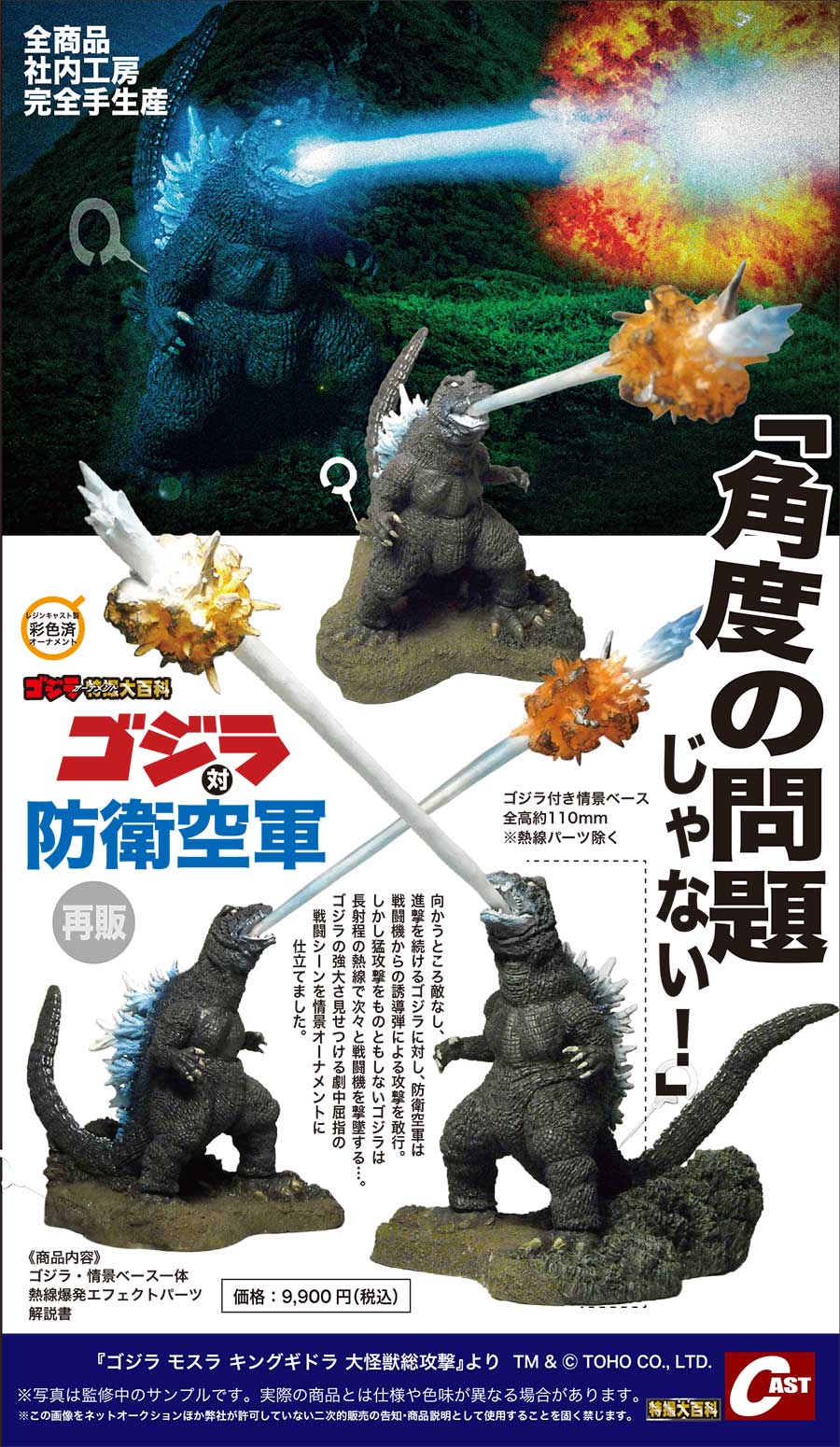
Merchandise
Trivia
- The sole F-7J pilot seen in the film is played by frequent Godzilla series actor Takehiro Murata.
- The length of the F-7J is shorter compared to real Sukhoi fighters; by contrast, the F-7J's weight is heavier than real Sukhoi aircraft.
- The English dub of the film incorrectly describes the laser-guided bombs dropped by the F-7Js as missiles.
Notes
- Grouped references
References
This is a list of references for F-7J. These citations are used to identify the reliable sources on which this article is based. These references appear inside articles in the form of superscript numbers, which look like this: [1]
|
Bibliography
- Godzilla, Mothra and King Ghidorah: Giant Monsters All-Out Attack (theater program). Toho. 15 December 2001.
- Imanishi, Chizuko; Sasaki, Atsushi; Kobayashi, Atsushi (15 December 2001). Godzilla, Mothra and King Ghidorah: Giant Monsters All-Out Attack. Toho. ISBN 4-924609-80-3.
- Iwahata, Toshiaki (15 January 2002). Godzilla, Mothra and King Ghidorah: Giant Monsters All-Out Attack Super Encyclopedia. Kodansha. ISBN 4-06-304474-2.
- Yokoo, Michio, ed. (20 January 2002). Godzilla, Mothra and King Ghidorah: Giant Monsters All-Out Attack. Tokuma Shoten. ISBN 4-19-760529-3.
- Godzilla, Mothra and King Ghidorah: Giant Monsters All-Out Attack Completion. Hobby Japan. 31 March 2022. ISBN 978-4798627793.

|

|

|
Comments
Showing 4 comments. When commenting, please remain respectful of other users, stay on topic, and avoid role-playing and excessive punctuation. Comments which violate these guidelines may be removed by administrators.