

Sandbox:Ginza
|
This page is a sandbox. Sandboxed pages are unfinished and not yet approved. Information found here may be unpolished or unverified. |
|---|
The Ginza District is a district of Tokyo, Japan. Established in the 16th century, the Ginza District has been notable for being attacked by many giant monsters throughout the years.
History
| This section is a work in progress. Please help in the creation of this article by expanding or improving it. |
- Godzilla (1954)
- Invisible Man (1954) [mentioned]
- Battle in Outer Space (1959)
- King Kong vs. Godzilla (1963) [U.S. version]
- Atragon (1963)
- Dogora (1964)
- Konto 55: The Great Outer Space Adventure (1969)
- Sinking of Japan (2006)
- Shin Godzilla (2016)
- Godzilla Appears at Godzilla Fest (2020)
- Godzilla Minus One (2023)
Showa era
Godzilla (1954)
After the giant monster known as Godzilla made landfall in Tokyo for the second time, he started making his way through the city. Godzilla soon entered the Ginza District, destroying large parts of it. As he continued his rampage throughout the district, Godzilla came upon the Wako Main Building. The clocktower on top of the building started ringing, and Godzilla roared at it. The monster tore down the clocktower and part of the building with ease, and then continued his march through the district.
Reiwa era
Godzilla Minus One
In March 1947, Noriko Oishi, Koichi Shikishima's girlfriend and Akiko's adoptive mother, secured a desk job in Tokyo's prospering Ginza district. She explained to Shikishima that she wanted to be able to support herself, lest she keep him from finding a wife.
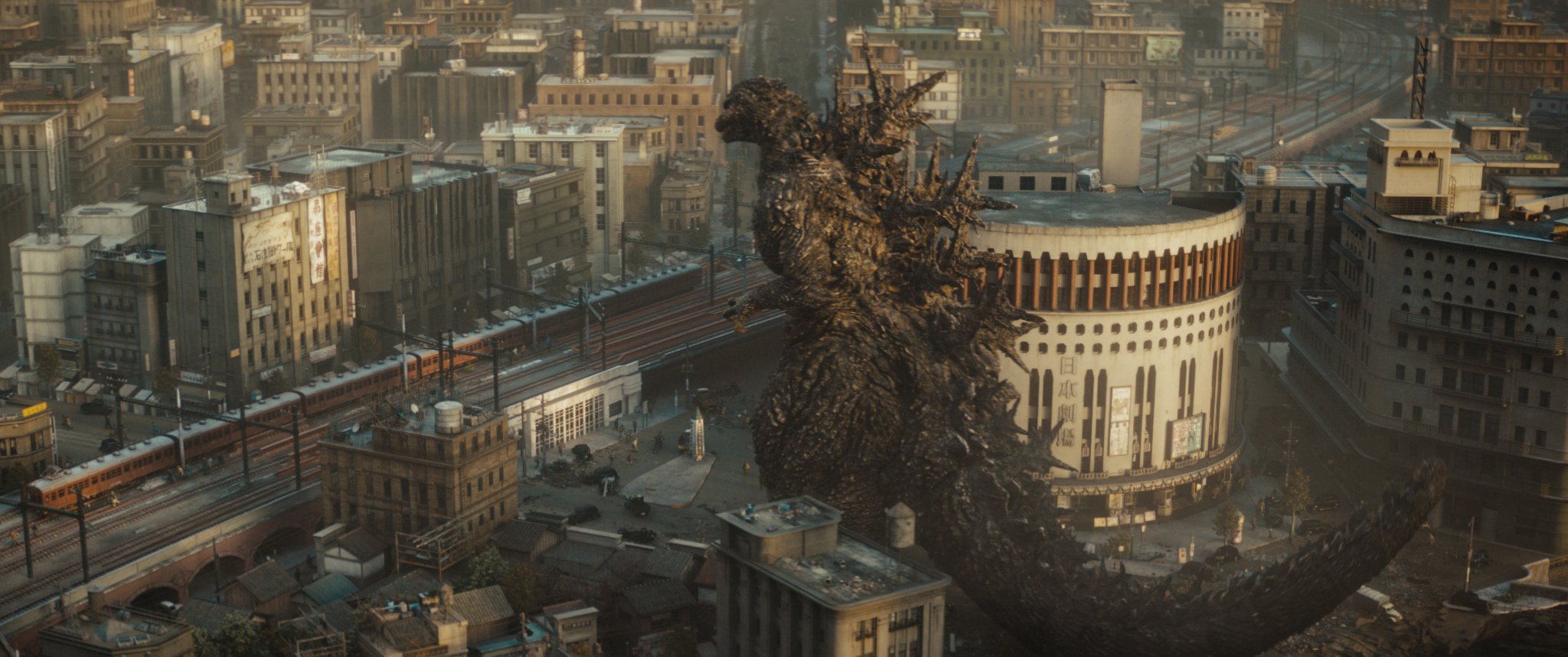
In May 1947, the giant creature Godzilla broke through the mine blockade surrounding Tokyo and landed in Ginza. The monster stomped through the city, knocking over power lines and vehicles with each footstep. Oishi's train was forced to stop when Godzilla threw a train car into its path, and she saw the monster for the first time. He advanced toward her train, trampling countless civilians on the Sukiya Bridge in the process, and bit down on it. Left dangling above the Sotobori moat as he stood up, she let herself fall, narrowly avoiding the car as he dropped it. Godzilla continued his frenzied rampage, destroying the Nippon Theater and killing several reporters broadcasting from a rooftop. As he approached Oishi, she froze up until Shikishima came to lead her away. Four Type 4 Chi-To medium tanks positioned in front of the National Diet Building fired at the gargantuan beast. Godzilla, unhurt and angered, charged up his atomic breath and blasted it toward the tanks, causing a nuclear explosion that flattened most of the surrounding area. The monster roared at the black mushroom cloud he created before returning to the sea, leaving an estimated 30,000 civilians killed or injured and 20,000 houses and other buildings destroyed. The area of his rampage was cordoned off due to the high radiation levels, with scientists collecting shards of Godzilla from the debris.
Video games
- Godzilla (1993) – NEC/Hudson Soft TurboDuo, TurboGrafx-CD/CD-ROM²
Books
- Godzilla Minus One (2023)
Godzilla Minus One
In the film's novelization, several details are specified. During the panic of Godzilla's arrival in Ginza, a car crashes into a light pole. A person also gets caught in an exit door due to the masses of people pouring out.[1] Fleeing citizens fall into the river below after Godzilla's weight causes the Sukiya Bridge to buckle, and more people are crushed when the bridge's pieces fall on them.[2] One of the announcers reporting on the Ginza attack, identified as Tokuda, compares the destruction to the Great Tokyo Air Raid.[3] In Ginza, Godzilla does not roar up at the mushroom cloud resulting from his atomic breath and instead stands still for a moment before moving onward.[4] The recording of Godzilla's roar used to lure him to Sagami Bay was found in the ruins of Ginza, made by one of the reporters that he killed.[5]
References
This is a list of references for Ginza. These citations are used to identify the reliable sources on which this article is based. These references appear inside articles in the form of superscript numbers, which look like this: [1]
|
Bibliography
- Yamazaki, Takashi (8 November 2023). Novel Version: Godzilla Minus One. Shueisha. ISBN 978-4-08-680525-4.
Comments
Showing 5 comments. When commenting, please remain respectful of other users, stay on topic, and avoid role-playing and excessive punctuation. Comments which violate these guidelines may be removed by administrators.