

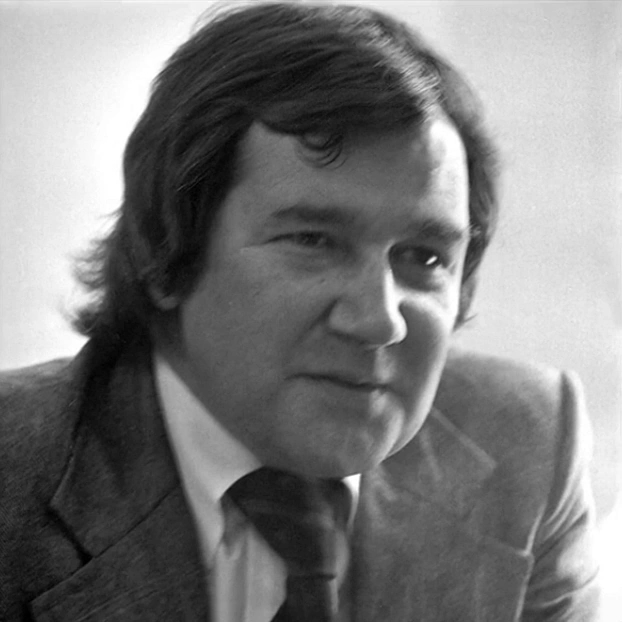
Warren Rooke
| ||||||||||||||||||||||||||||||||||||||||||||||
| ||||||||||||||||||||||||||||||||||||||||||||||

“
|
I did dub one time with Warren Rooke when he was in town and stopped by to dub a day for old times’ sake. He was witty and fun to be around. He was very short of stature. Once, as he was recording, he finished his line before the actor onscreen did. 'Short!' (dubbing director Ina Chow) called out. Replied something like, 'I know I’m short; you don’t have to rub it in,' which got a big laugh.
|
„
|
— From Brett Homenick's interview with Craig Allen[3] |
Roderick Warren Rooke is an Australian-born former Hong Kong broadcaster and film dubber. Starting out in film dubbing in the mid-1960s, he became prolific by the 1970s and was still semi-active as late as the 1990s. He is best remembered in kaiju fandom circles for providing the voice of Hiroshi Jinkawa in the English dub of Godzilla vs. Megalon (1973) and Genichiro Shiragami in the English dub of Godzilla vs. Biollante (1989).
Biography
Warren Rooke attended Bunbury High School in his hometown.[4] In his late teens, at his father's urging, Rooke began studying chemistry at a technical college while apprenticing as a chemist at a shop owned by his uncle, who headed the pharmaceutical guild in Western Australia.[2] After about six months, he rebelled against his father and "joined up with a group of friends who wandered around the state of Western Australia as itinerant farmer labourers, picking apples in the south or cotton way up in the north."[2]
Around 1959, after he became aware of his son's itinerant farming, Rooke's father had him work the record section of his electrical appliance store in Bridgetown.[5] Later, Rooke was offered a job at a newspaper in Bunbury, which he had occasionally written for previously.[2] After about eleven months working at the newspaper, Rooke applied for a cadetship with the then Australian Broadcasting Commission (ABC). In a 1982 interview, Rooke explained how he got the cadetship: "I worked out that all the men on the selection committee were cricketers. I loathe the sport myself, but for two days and nights I learnt everything about the subject I could. The minute I got in there I started talking about cricket with all the enthusiasm I could muster."[2] For three months he worked at ABC in Perth, and subsequently in Kalgoorlie–Boulder. Rooke then finished his cadetship back in Perth, taking two and a half years in total, and afterward joined ABC's radio newsroom.[2]
At age 22, wanting to explore the world, Rooke moved to Singapore; failing to find a worthwhile job but not wanting to return home, he sailed to Hong Kong, arriving on December 13, 1963.[2] One day later, Rooke approached the public broadcasting station Radio Hong Kong (RHK) for work; he was interviewed by RHK broadcaster and film dubbing group organizer Ted Thomas. In 1982, Thomas recalled that Rooke "had one blue tie, which he wore from that day on for the next six months. But we knew that he was an extremely good broadcaster with solid experience of news reporting — something which we were very weak on at that time."[2] RHK hired Rooke as a freelance reporter, and he soon became editor of the radio news program Topics, which featured local reports by freelancers.[2]
In the mid-1960s, around the time that he became editor for Topics, Rooke began moonlighting as a film dubber for Ted Thomas's dubbing group. Several freelance reporters who subsequently signed on to Topics, such as Barry Haigh and Saul Lockhart, also became film dubbers for Thomas’s group not long after they signed on.[6][7] In 1966, Rooke dubbed The War of the Gargantuas for an unknown group during Thomas's year-long leave;[8] that same year, RHK promoted Rooke to program officer, and two years later, he was promoted in turn to program supervisor.[9]
Rooke traveled to the United States to participate in the 1968-1969 Multi-National Foreign Journalists Project hosted by Indiana University (IU) and sponsored by the United States Department of State. The annual three-month project had the aim of teaching U.S. standards of journalism through seminars at IU followed by practical experience at major U.S. news organizations. Rooke and the other participating journalists arrived in Bloomington, Indiana on September 15, 1968, after spending the previous week being briefed in Washington, D.C. by major government and military officials on topics including U.S. foreign policy, civil rights, and the space race.[10][11] For the second phase of the project, which started on October 28 and included coverage of the 1968 United States presidential election, Rooke was assigned to the American Broadcasting Company and the commercial radio station KSFO in San Francisco.[12]
After completing his internship, Rooke began his return trip to Hong Kong on January 18, 1969.[13][14] Rooke also took leave from July 16, 1969 to January 22, 1970.[15] His internship in the U.S. and his leave correspond to his absence from film dubbing during the same time frames.
Throughout the 1970s, while rising through the ranks of the rechristened Radio Television Hong Kong (RTHK), Rooke dubbed prolifically as a core member of Ted Thomas's group.[16] Former scriptwriter and dubbing director Graham Earnshaw recalls:[17]
Warren, a broadcaster with a Hongkong radio station, was the most versatile of our main dubbers, and I remember one night when due to bad organisation on my part, or perhaps a shortage of dubbers, two of his characters found themselves talking to each other in a certain loop. He recorded it straight off, talking to himself in two different voices for nearly a minute, switching voices back and forth, and simultaneously matching the English words to the Chinese lip flaps. A virtuoso performance. A pity there’s no Oscar awarded for dubbing.
Rooke continued occasionally dubbing into the 1980s and 1990s, often for Omni Productions, the successor to Ted Thomas's group run by Rik Thomas and Ina Chow,[a] but also for Vaughan Savidge's group; he even narrated Savidge's gag-dubbed parody short Chop Chop.[18]
By 1976, Rooke had become controller of RTHK's English Programme Service.[19] By 1981, Rooke had become editor of the News and Current Affairs section of the radio division of RTHK.[20] In 1986, Rooke was moved to head of the RTHK business and financial unit, and a year later started hosting a show for RTHK Radio 3 called Money This Week.[21][22]
Rooke left RTHK in 1989.[23] In 1990, former film dubber, broadcaster and managing director of the tourist-focused Hongkong Channel Hal Archer gathered Rooke and other broadcasters who had also done film dubbing, such as Chris Hilton and Bill Yim, to host programs for his channel.[24]
Rooke has lived in Macau since January 1996, where seventeen years earlier he had bought a traditional Chinese house to use as a weekend retreat.[25][26] Former Omni Productions film dubber Craig Allen recalls that after moving to Macau, Rooke stopped in Hong Kong to dub at least one more time.[3]
Selected filmography
- Note: Films’ ordering and years correspond to their domestic releases and not necessarily their dubs’ first availability.
- Gamera vs. Barugon (1966) as Ichiro Hirata / Dr. Sato / Professor Amano [voices; English export dub]
- The War of the Gargantuas (1966) as Lt. Col. Kazama / reporter / radio announcer [voices; English export dub]
- Return of Daimajin (1966) as Lord Juro Chigusa [voice; English export dub]
- Gamera vs. Gyaos (1967) as rancher / Highway Development Corporation director / Prefectural Police chief [voices; English export dub]
- Godzilla vs. Megalon (1973) as Hiroshi Jinkawa / truck driver's assistant / Seatopian agent in gray [voices; English export dub]
- Hanuman and the Seven Ultramen (1974) as Ultraman / Sisuliya / robber in blue [voices; English export dub]
- Mars Men (1976) as scientist at space associates meeting [voice; English export dub]
- Magnitude 7.9 (1980) as Masayuki Hashizume / Chief Cabinet Secretary / Director General of the National Land Agency / Professor Watanabe / Hayashi [voices; English export dub]
- Godzilla vs. Biollante (1989) as Dr. Genichiro Shiragami / trailer narrator [voices; English export dub]
- Godzilla vs. King Ghidorah (1991) as Director General of Defense [voice; English export dub]
- Godzilla vs. Mechagodzilla II (1993) as Colonel Takaaki Aso [voice; original Omni Productions English dub][b]
- Orochi, the Eight-Headed Dragon (1994) as Genbu [voice; English export dub]
Gallery
-
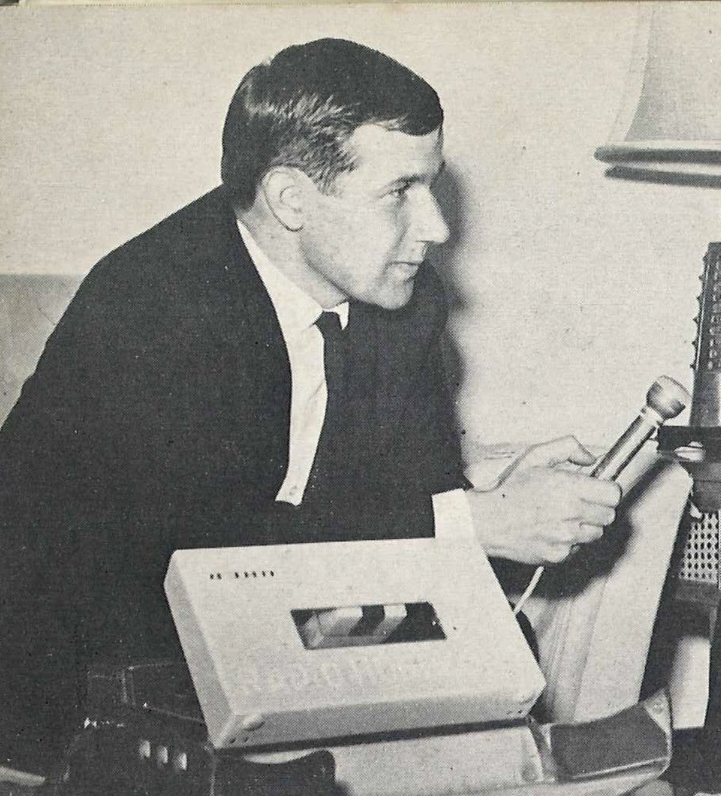
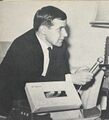 Warren Rooke in 1966
 -
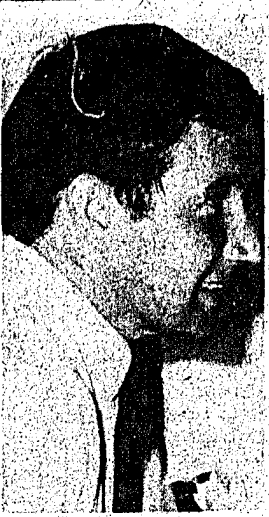
 Warren Rooke in 1980
 -
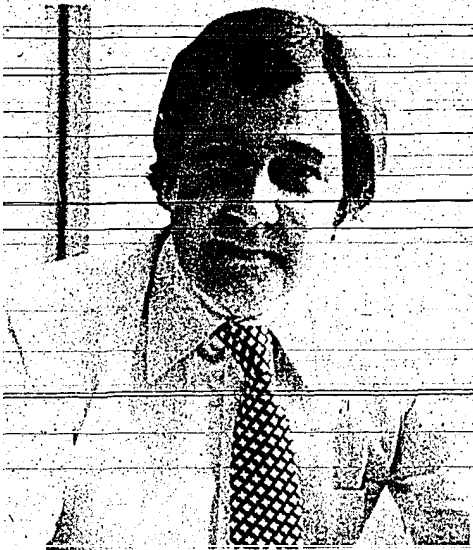
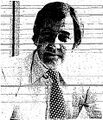 Warren Rooke in 1982
 -
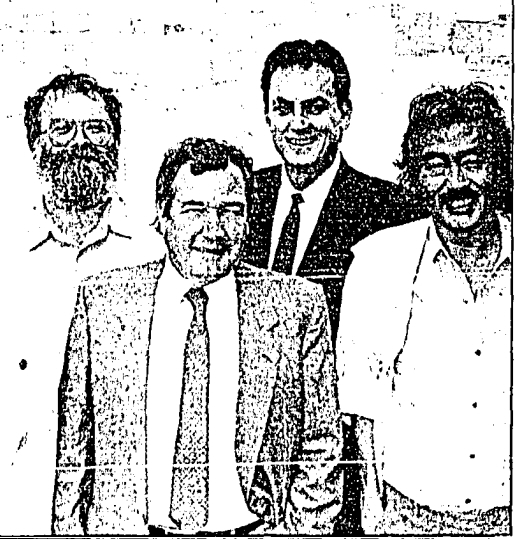
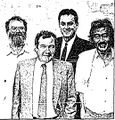 From left: film dubbers Chris Hilton, Warren Rooke, Hal Archer, and Bill Yim in 1990
Videos
|
See also
External links
Notes
References
This is a list of references for Warren Rooke. These citations are used to identify the reliable sources on which this article is based. These references appear inside articles in the form of superscript numbers, which look like this: [1]
Bibliography
- Staff list, Hong Kong Government, 1972. 1 October 1972 – via DigitalRepository @HKUL.
- "The news according to Rooke". South China Morning Post. 26 December 1982 – via Proquest.com.
- The Kingia (PDF). December 1959 – via Collections WA.
- "New Radio HK programme". South China Morning Post. 31 October 1965 – via Proquest.com.
- Hong Kong Annual Departmental Report by the Director of Broadcasting D. E. Brooks for the Financial Year 1968 - 69*. 31 March 1969 – via DigitalRepository @HKUL.
- "Foreign Journalists To Be Visiting IU". The Herald-Times. 12 September 1968 – via Newspapers.com.
- "Foreign Journalists Receive Assignments". The Herald-Times. 17 October 1968 – via Newspapers.com.
- "Journalists End Study of U.S.". The Cincinnati Post. 13 January 1969 – via Newspapers.com.
- "OUT AND ABOUT". South China Morning Post. 22 November 1971 – via Proquest.com.
- "Radio bans six songs". South China Morning Post. 22 April 1976 – via Proquest.com.
- "Why Krugerrand rate is quoted". South China Morning Post. 12 November 1981 – via Proquest.com.
- "Station 'in limbo' awaiting broadcasting review report". South China Morning Post. 16 November 1986 – via Proquest.com.
- "RTHK staff asking for a ghost buster". South China Morning Post. 2 December 1987 – via Proquest.com.
- "Veterans' video showcase". South China Morning Post. 26 October 1990 – via Proquest.com.
- "The battle for independence: Broadcast veteran Warren Rooke recalls the days of official interference". South China Morning Post. 5 May 1996 – via Proquest.com.
- "In search of the good life in Macau: Increasing numbers of people are leaving Hong Kong to live and work in the Portuguese enclave. Annabel Doling reports". South China Morning Post. 16 February 1996 – via Proquest.com.
|
| ||
Comments
Showing 8 comments. When commenting, please remain respectful of other users, stay on topic, and avoid role-playing and excessive punctuation. Comments which violate these guidelines may be removed by administrators.

|