

Nippon Chinbotsu: Television Series (TV 1974–1975)
| |||||||||||||||||||||||||||||||||||||||||||||||||||||||||||||||||||||||||||||
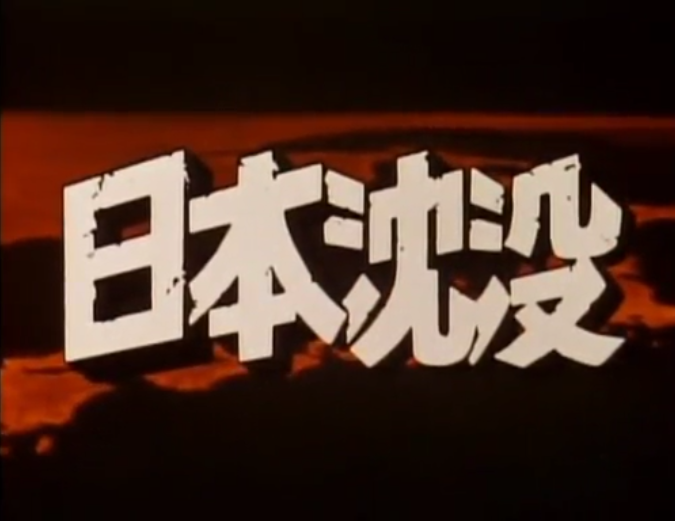
Nippon Chinbotsu: Television Series (日本沈没 Nippon Chinbotsu, lit. "Japan Sinks"; released on home video as 日本沈没 TVシリーズ Nippon Chinbotsu: Terebi Shirīzu, lit. "Japan Sinks: TV Series") is a Japanese tokusatsu science-fiction disaster series developed by Tomoyuki Tanaka based on the 1973 novel Japan Sinks by Sakyo Komatsu. Produced for TBS by Toho Eizo with uncredited special effects cooperation from Nihon Gendai Kikaku, it was the second live-action adaptation of Japan Sinks after the 1973 Toho Pictures/Toho Eizo film Submersion of Japan, though the two are not connected. The series aired from October 6, 1974, to March 30, 1975, after which a 90-minute TV movie compiled from various episodes was aired on December 31, 1975.
Plot
|
“I knew that『plot』wasn't up to much.” This plot synopsis is missing or incomplete. Please help by editing this section. |
|---|
To be added.
Episodes
| No. | Title | Directed by | Written by | Director of special effects |
Air date |
|---|---|---|---|---|---|
| 1 | "The Raging Sea" | Jun Fukuda | Yuichiro Yamane | Yoshio Tabuchi | 10/06/1974 |
| 2 | "Undersea Torrent" | Kiyoshi Nishimura | 10/13/1974 | ||
| 3 | "White Fissure" | 10/20/1974 | |||
| 4 | "When the Sea Turns Violent" | Takashi Nagano | Koichi Kawakita | 10/27/1974 | |
| 5 | "The Island Is Sinking" | Shukei Nagasaka | 11/03/1974 | ||
| 6 | "The Earth Wails in Sorrow" | Kiyoshi Nishimura | Yoshio Tabuchi | 11/10/1974 | |
| 7 | "A Black Tornado, the Fang of the Sky" | Yuichiro Yamane | 11/17/1974 | ||
| 8 | "The Furious Stream" | Eizo Yamagiwa | Koichi Takano | 11/24/1974 | |
| 9 | "Mystery of the Undersea Cave" | Toshiro Ishido | 12/01/1974 | ||
| 10 | "The Aso Firefall" | Minoru Kanaya | Shukei Nagasaka | Koichi Kawakita | 12/08/1974 |
| 11 | "An Aurora Over Kyoto!!" | Yuichiro Yamane | Koichi Takano | 12/15/1974 | |
| 12 | "Kyoto Is in Danger" | Tadashi Mafune | 12/22/1974 | ||
| 13 | "Kyoto Crumbles" | 12/29/1974 | |||
| 14 | "Tomorrow's Love" | Takashi Nagano | Shukei Nagasaka | Koichi Kawakita | 01/05/1975 |
| 15 | "The Oil Platform Explodes" | 01/12/1975 | |||
| 16 | "Kagoshima Bay SOS!" | Eizo Yamagiwa | Yuichiro Yamane | Koichi Takano | 01/19/1975 |
| 17 | "Amakusa Vanished!" | 01/26/1975 | |||
| 18 | "Crisis Approaches Ogouchi Dam" | Kiyoshi Nishimura | 02/02/1975 | ||
| 19 | "Farewell, Hakodate" | Minoru Kanaya | Shukei Nagasaka | Koichi Kawakita | 02/09/1975 |
| 20 | "Hokkaido Sinks" | 02/16/1975 | |||
| 21 | "Flame Spreads Through Izu Oshima" | Takashi Nagano | Koichi Takano | 02/23/1975 | |
| 22 | "The Japanese Islands Break Apart" | Yuichiro Yamane | 03/02/1975 | ||
| 23 | "Kamakura Disappeared Into the Sea" | Minoru Kanaya | 03/09/1975 | ||
| 24 | "Get Out, People of Tokyo" | 03/16/1975 | |||
| 25 | "Ah! Tokyo Is Sinking" | Jun Fukuda | 03/23/1975 | ||
| 26 | "Tokyo's Final Day" | 03/30/1975 |
Staff
Staff role on the left, staff member's name on the right.
- Directed by Jun Fukuda, Kiyoshi Nishimura, Takashi Nagano, Eizo Yamagiwa, Tadashi Mafune
- Written by Yuichiro Yamane, Shukei Nagasaka, Toshiro Ishido
- Based on the novel Japan Sinks by Sakyo Komatsu
- Planned by[a] Tomoyuki Tanaka
- Produced by Susumu Saito, Hitoshi Ogura, Yoji Hashimoto, Takao Yasuda
- Music by Kenjiro Hirose
- Theme song "Love of Tomorrow" and insert song "Little Bird"
- Performed by Hiroshi Itsuki
- Lyrics by Yoko Yamaguchi
- Composed by Kyohei Tsutsumi
- Arranged by Bob Sakuma
- Cinematography by Kiyoshi Hasegawa, Shoji Utsumi, Senkichi Nagai
- Edited by Shosuke Funazawa
- Production design by Masayasu Ito, Shoichi Sasagawa
- First assistant directors Taku Shinjo, Toshio Sanagawa, Tetsutaro Hagiwara
- Directors of special effects Yoshio Tabuchi, Koichi Kawakita, Koichi Takano[b]
- First assistant directors of special effects Eiichi Asada, Shinichi Kamisawa
Cast
|
Actor's name on the left, character played on the right.
|
|
Appearances
Weapons, vehicles, and races

Development
Nippon Chinbotsu: Television Series was based on Sakyo Komatsu's 1973 novel Japan Sinks, the film rights to which had been purchased by Toho Eizo producer Tomoyuki Tanaka before it even released.[2] These rights were first exercised for the 1973 film Submersion of Japan, produced by Toho Eizo and Toho Pictures. Accounts differ on the origin of the series; according to special effects assistant director Eiichi Asada, it was devised to capitalize on Submersion of Japan's success,[3] whereas special effects director Koichi Kawakita recalled that it was planned at the same time as the film, explicitly rejecting the premise that it was made to cash in on the film.[4]
Production
The series was produced for ¥500 million, an unprecedented budget for TV series of the time.[5] According to Kawakita, two cameras were brought to the set of Submersion of Japan to capture material for the show, but most of it went unused, perhaps due to difficulty disguising the film's Tokyo setting for the show's varied locations.[4] The bulk of the special effects shooting thus began the following year, 1974, and overlapped with that of Prophecies of Nostradamus. The choice for the series' first special effects director was narrowed to either Kawakita or Yoshio Tabuchi, with the other to become Teruyoshi Nakano's assistant director for Nostradamus. The choice was left to the two of them to figure out, and they decided to play rock paper scissors for first pick; Kawakita won, and chose to work on Nostradamus, as he was more interested in film and found Nostradamus's fantastical premise to be more freeing than the science-based Nippon Chinbotsu: Television Series.[6]
Unlike Nostradamus, however, the series' effects were not produced at Toho Studios, but rather at the facilities of Nihon Gendai Kikaku in Komae.[3][7] Asada, who worked on the series' first three episodes, recalled in 2022: "The tokusatsu [was] done at ... a small studio in Komae, Tokyo. There was no air-conditioning in the studio, so it was very hot. ... For the movie [Submersion of Japan], the special effects scenes, like the ones that take place at the bottom of the ocean, were filmed on sets built in the largest studio at Toho, whereas the Komae studio was only one fourth or fifth of the size, so we couldn't film the same kind of effect there. We could film scenes that only required small sets at the Komae studio, but, for special effects scenes like the ones that take place at the bottom of the ocean, we had to use stock footage that had been shot for the film version".[3] Other stock footage included unused portions of the scene from Nostradamus where a ship encounters icebergs.[8]
After Kawakita finished his work on Nostradamus, his help was requested on the series by one of the producers, Yoji Hashimoto. The crew had been experiencing difficulty realizing some of the effects, including a sequence involving the submarines Wadatsumi and Kermadec in the Japan Trench, which did not appear to be convincingly set underwater. Kawakita agreed to take over for Tabuchi on episodes 4 and 5, the first sequence he directed being a series of underwater shots for the latter, for which a number of small fish were caught from the Tama River and filmed in a pool.[9] Of his experience with the show, Kawakita stated, "Unlike with movies, we had to consider costs and efficiency, so it wasn't easy to shoot things as I wanted".[10] Though Tabuchi and Kawakita both worked on a few more episodes after this, the majority of the show's special effects were ultimately directed by Nihon Gendai Kikaku's Koichi Takano,[7] another former acolyte of Eiji Tsuburaya.
According to an Associated Press (AP) story published shortly after the series' conclusion, TBS officials reported that two days' worth of shooting were required to produce two minutes of special effects footage.[11] Asada, meanwhile, placed the overall length of the shoots he was involved in at "maybe five or six days" apiece.[3] The same AP report also noted that smoke and fire used on the Tokyo Tower miniature set (featured in episode 25) were created with "burning glue" and "titanium chloride," respectively.[11]
The human portions of the series' first, penultimate, and final episodes were directed by Godzilla series veteran Jun Fukuda, one of his last science-fiction assignments for the Toho Group.
Alternate titles
- Japan Sinks (literal Japanese title)
- Submersion of Japan (alternate translation)
- The Submersion of Japan (alternate translation)[11]
- Sinking of Japan (alternate translation)
- Japan Sinks: TV Series (Japanese home video title)
- Japan Sinks: Television Series (Japanese home video title)
Ratings and reception
According to a 1975 report from the Associated Press, Nippon Chinbotsu: Television Series failed to meet TBS's expectations, debuting with a rating of 1.8 which fell to 1.3 by the final episode. The report speculated that audiences may have been turned away by the series' acting, as "[t]he story of the ever-eroding archipelago seldom got away from melodrama." However, it complimented, "the special effects were something else. ... Each installment was preceded and followed by a special announcement informing viewers they were watching a fictional account--not newsreel film--because the destruction looked chillingly authentic at times." It concluded, "after the two-year media blitz [spawned by Japan Sinks], the Japanese seem to have lost interest in the theme. And [Nippon Chinbotsu: Television Series] lost the TV ratings battle to a historical drama of sex, violence and court intrigue in 17th-century Japan".[11]
Video releases
|
Amuse Soft LaserDisc (October 25, 1996) [LD-BOX D-1]
Amuse Soft LaserDisc (February 21, 1997) [LD-BOX D-2]
Amuse Soft DVD (April 27, 2001) [M-1.0]
Amuse Soft DVD (April 27, 2001) [M-2.0]
Amuse Soft DVD (April 27, 2001) [M-3.0]
Amuse Soft DVD (May 25, 2001) [M-4.0]
Amuse Soft DVD (May 25, 2001) [M-5.0]
|
Amuse Soft DVD (May 25, 2001) [M-6.0]
Amuse Soft DVD (June 22, 2001) [M-7.0]
Amuse Soft DVD (June 22, 2001) [M-8.0]
Amuse Soft DVD (June 22, 2001) [M-9.0]
Amuse Soft DVD (July 7, 2006) [Premium Hazard BOX]
|
Trivia
- A miniature used for the Wadatsumi in this series was modified to portray the NSTL Ripley in Godzilla vs. King Ghidorah (1991).[12]
- A shot from episode 4 of Himeji Castle's stone wall collapsing was reused during Battra's attack on Nagoya Castle in Godzilla vs. Mothra (1992).[13]
See also
External links
Notes
- ↑ Title used in the series' credits. The packaging for the series' LaserDisc and DVD releases instead bill Tanaka as executive producer.
- ↑ Guy Mariner Tucker alleges in his 1996 book Age of the Gods that Teruyoshi Nakano was credited as the series' director of special effects despite having no involvement.[1] This is demonstrably false, as Nakano's name never appears in the series' credits.
References
This is a list of references for Nippon Chinbotsu: Television Series. These citations are used to identify the reliable sources on which this article is based. These references appear inside articles in the form of superscript numbers, which look like this: [1]
|
Bibliography
- Shlacter, Barry (1979). "Televersion: Submersion of Japan". Japanese Fantasy Film Journal. No. 12 – via Internet Archive.
- Encyclopedia of Godzilla (Mechagodzilla Edition). Editor-in-chief: Kawakita, Koichi. Gakken. 10 December 1993. ISBN 405600174X.CS1 maint: others (link)
- Tucker, Guy Mariner (1996). Age of the Gods: A History of the Japanese Fantasy Film. Feral House.
- Kawakita, Koichi (22 January 2010). The Spirit of Tokusatsu: Toho Special Effects Battle Chronicle. Yosensha. ISBN 978-4-86248-515-1.
- Nakamura, Satoshi (10 February 2012). "Burning Column No. 010: The Stock Footage of Heisei Godzilla". Heisei Godzilla Perfection. ASCII MEDIA WORKS. ISBN 978-4-04-886119-9.
- Asai, Kazuyasu (28 September 2012). "Submersion of Japan (2nd Draft—Final Draft—1973.9.5), Submersion of Japan (3rd Draft—Final Draft—1973.9.22)". Toho Special Effects Movie Complete Works. villagebooks. ISBN 978-4-86491-013-2.
- Ozawa, Ryoko; Murai, Shugo; Imai, Atsushi; Nakamura, Satoshi; Tomoi, Taketo; Shimazaki, Jun, eds. (20 July 2018). All Toho Mechanic Pictorial Book (2nd ed.). Yosensha. ISBN 978-4-8003-1461-1.
- Iwahata, Toshiaki (25 February 2020). Character Complete Works: Special Effects Complete History – 1970s Hero Complete Works (4th ed.). Kodansha. ISBN 978-4-06-219821-9.
|
| ||
Comments
Showing 7 comments. When commenting, please remain respectful of other users, stay on topic, and avoid role-playing and excessive punctuation. Comments which violate these guidelines may be removed by administrators.

|

|

|