Welcome to Wikizilla! — Please log in to contribute. NOTICE: Account creation has been temporarily disabled due to excessive spam.
Godzilla's roar
From Wikizilla, the kaiju encyclopedia
Godzilla's roar is a famous sound effect. Originally created by composer Akira Ifukube, his assistant Sei Ikeno, and sound technician Ichiro Minawa in 1954,[1] it has been reinterpreted by various other sound designers over the decades.
When he first signed onto Godzilla, composer Akira Ifukube thought that the monster, being a reptile, should not roar at all.[1] Director Ishiro Honda explained it as another consequence of his mutation by nuclear testing. Sound technicians Ichiro Minawa and Hisashi Shimonaga tried modifying the cries of lions, tigers, and night herons recorded at the Ueno Zoo, but everything they produced still sounded too natural. It was Ifukube who came up with the idea of using a musical instrument: the contrabass. He unwound the E string and recorded his assistant, Sei Ikeno, drawing his hands across it with gloves covered in pine tar. Minawa then manipulated the speed of the recordings, added echoes, and overlaid some of the animal sounds that he had previously gathered. This roar would later be altered for use as the roar of other Toho monsters, including Varan, Baragon, and Gorosaurus. Godzilla's roar was increased in speed and given new variants starting in King Kong vs. Godzilla, and would remain mostly unchanged for the rest of the Showa series. Manda's grunts were repurposed for Godzilla from Ghidorah, the Three-Headed Monster onward, largely replacing the guttural grunts made using the contrabass and pine tar method, which disappeared in usage after Invasion of Astro-Monster.
Starting in The Return of Godzilla, Godzilla's roar reverted to the slower speed variants used throughout the the original film and Godzilla Raids Again, and concluded with a guttural sound. In Godzilla vs. Mothra, Godzilla's roar was changed again to use the higher speed variants used throughout the Showa era, with the guttural sounds at the end removed and additional processing applied.
Sound designers Erik Aadahl and Ethan Van Der Ryn created a new Godzilla roar from scratch for Legendary Pictures' 2014 reboot. They first tried the same glove-on-a-contrabass technique pioneered by Akira Ifukube, but found the results weren't quite right for the era of 12-channel IMAX theaters. Their breakthrough was metal friction. According to Aadahl, "Dried ice supercools certains types of metal, and it starts contracting and vibrating and produces this shrieking and bellowing."[4] For the rumble at the end of the roar, they manipulated recordings of a potted plant raked across concrete.[4] To capture how the roars would resonate in a city, they blasted them from the Rolling Stones' tour speakers in a Warner Bros. backlot, which could be heard from about three miles away.[5] This roar returned in subsequent Monsterverse films; in Godzilla: King of the Monsters, it was mixed with many of Godzilla's roars from the Showa series. In Godzilla vs. Kong, Godzilla's roar from the 2012Godzilla Comic-Con teaser and a recycled variation of his extended roar from the main trailer of the 2014 film are used. Godzilla's roar from The Return of Godzilla can be faintly heard when he is ambushed by Kong during their fight in Hong Kong. In a trailer for the PUBG Mobile x Godzilla vs. Kong collaboration event, Godzilla possesses the TriStar Godzilla's roar.[6] For Godzilla x Kong: The New Empire, Godzilla was given some new roars that occasionally incorporated the Showa era roars into them to produce a reverberative effect. After evolving, Godzilla's roars were extended and given a slightly higher-pitched ending.
Godzilla's roars and sound effects throughout the Monsterverse
Godzilla's first and second forms never roar in Shin Godzilla, but the third and fourth forms do. The third form utilizes Godzilla's roars from the original 1954 film, while his fourth form primarily uses Godzilla's roars from King Kong vs. Godzilla through Terror of Mechagodzilla. Just before being frozen at the film's climax, Godzilla's fourth form emits a roar from The Return of Godzilla. Though the filmmakers experimented with new sounds, they found they couldn't surpass the older ones.[7]
Godzilla Amphibia utilizes Varan's roars, which have also been reused for numerous other kaiju, such as Baragon and Gorosaurus, in the past. When using his flammable ice vapor, he reuses the 1954 Godzilla's roar. After evolving into Godzilla Terrestris, he uses Godzilla's roar from The Return of Godzilla, occasionally mixed with roars from the Millennium series. Godzilla Ultima's roars, just like Godzilla Terrestris', are a combination of the roars used by Godzilla in the early Heisei series and the Millennium series, sometimes mixed with his roars from the Showa series. The Showa Godzilla's roar is used when he fires his atomic breath rings.
In Godzilla Minus One, Godzilla reuses the roars of the first Godzilla from the opening titles of the 1954 film, but more amplified and with a reverberative quality. His initial form also uses this roar, with some additional snarls and screeches mixed in.
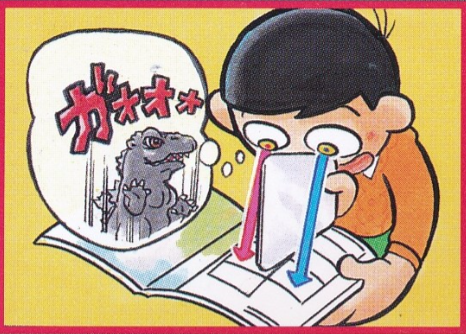
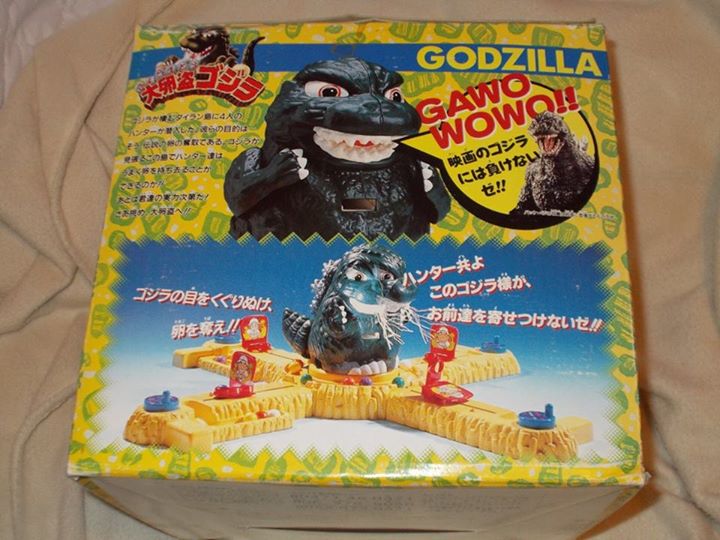
Godzilla's roar has been written out in comic books on numerous occasions, and not only as a simple "roar." In Marvel Comics' Godzilla series, Godzilla's roar was spelled "Mrawww." In Dark Horse's Godzilla publications and IDW Publishing's Godzilla: Rulers of Earth, Godzilla's roar was spelled "Skreeongk." In most of the other IDW comics, Godzilla's roar is spelled "Skreeonk." In Japanese, the official onomatopoeia for Godzilla's roar is "Gyaoon" (ギャオーン, Gyaōn) — additional "o"s can be added to extend the roar. Another onomatopoeia is "Gaooo" (ガオオオ).
While Toho is fiercely protective of Godzilla's likeness, his roar has been repeatedly used as a stock sound effect in film, television, and video games, as well as sampled in music. These lists are meant to be comprehensive, but given the broad subject matter, they may be incomplete.
A dragon in the Shaktimaan: The Animated Series episode "Kite Fright" (TriStar roar)
Zaraka in SuperCops vs. Supervillians (Monsterverse roar)
A giant Venus flytrap in The Tom and Jerry Show (Hanna-Barbera roar)
A dragon in The King’s Avatar Season 1
Sea Monster in Unicorn: Warriors Eternal
Fossa in All Hail King Julien!
DTZ in Chip 'n Dale: Rescue Rangers
Ragu in Dinosaur Squadron Koseidon episode 46
Video games
1985: Godzilla-like Kaiju in Time Gal
1999/07/25: Cassandra from Pico’s School
1999/11/22: Dogadon from Donkey Kong 64 (Hanna-Barbera roar)
2008/01/31: The Legendary Pokémon Palkia in Super Smash Bros. Brawl (Millennium roar)
2009/06/08: Thomp in Mario vs. Donkey Kong: Minis March Again (Hanna-Harbara Roar)
2014/11/11: An animatronic Tyrannosaurus rex and Plastic Man in LEGO Batman 3: Beyond Gotham (TriStar roar)
2019/05/28: Circus Baby from Five Nights at Freddy's: Help Wanted (Monsterverse roar)
2024/10/25: Metal Overlord from Sonic X Shadow Generations (1954 roar)
Music
1988/09/25: "Posse on Broadway" by Sir Mix-a-Lot
2006/02/21: "Woman from a Hell" by Acid Mothers (Heisei roar)
Trailers
2006/11/09: The Sandman in Spider-Man 3 (TriStar roar)
2025/04/22: Godzilla-like monster in Season 13 of Futurama
Miscellaneous
2012/07/23: Dinosaurs in the Dinosaurs vs. Aliens motion comic (TriStar roar)
2012/09/14: Rex in Toy Story Shorts: Partysaurus Rex
Unknown: Sock Monkey in Typhoon, an arcade ride, during "The Night at the Toy Store" track (Showa roar)
Trivia
In the DVD commentary for Monsters, Inc., Pete Docter revels that he originally wanted Ted, a giant Godzilla-like monster, to use Godzilla’s roar. As Pixar could not secure permission from Toho to use the roar, they replaced it with a chicken's clucking.
References
This is a list of references for Godzilla's roar. These citations are used to identify the reliable sources on which this article is based. These references appear inside articles in the form of superscript numbers, which look like this: [1]
↑Shinji Higuchi in G-Fan #116, p. 9-10, summer 2017.
Comments
Showing 60 comments. When commenting, please remain respectful of other users, stay on topic, and avoid role-playing and excessive punctuation. Comments which violate these guidelines may be removed by administrators.


 "Gaooo" used in Godzilla 1954-1999 Super Complete Works, page 175
 "Gawowowo" used in the box for a toy