

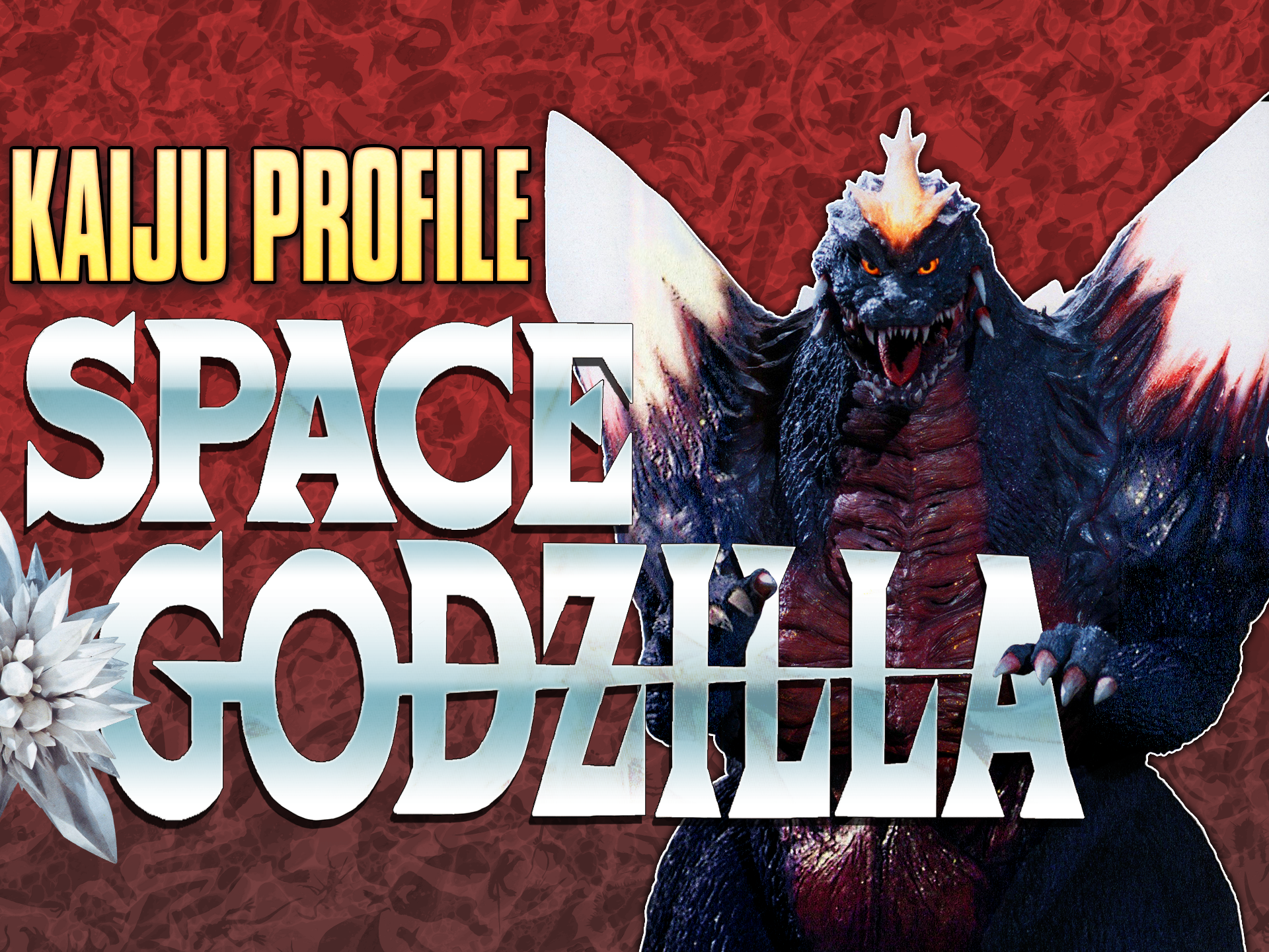
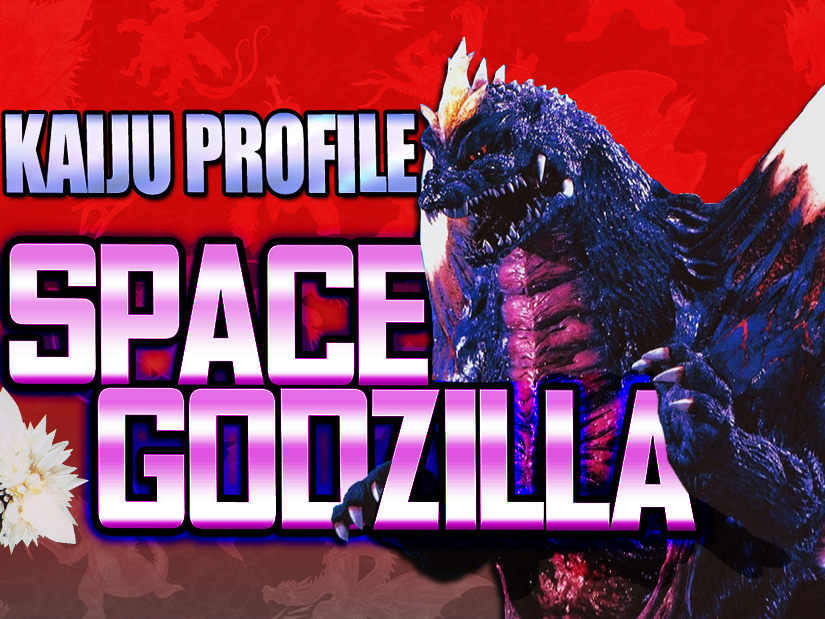
Kaiju Profile: SpaceGodzilla
|


VIDEOS
• The Godzilla Timeline
• Godzilla vs. King Ghidorah Time Travel
• Godzilla Misconceptions Vol. 1
• Inconsistent Stats Vol. 1
• Anime GODZILLA Timeline
• Zilla Name Controversy
• Anime GODZILLA Timeline Part 2
• History of Monarch (MonsterVerse Timeline)
• The Story of King Kong vs. Godzilla
• 2020 Kaiju Streaming & Home Video Guide
• Lost & Unreleased Kaiju Media
Godzilla 1954 • Titanosaurus
Showa King Ghidorah • Universal King Kong
Skeleturtle • Toho King Kong • Showa Mothra
Biollante • Kiryu • King Kong 2017
V-Rex • Gigan • SpaceGodzilla • Destoroyah
Hedorah • Monster X • Heisei Godzilla
Mechani-Kong • Godzilla 2017
Minilla • Gorosaurus • Fake Godzilla
Meat-Eater • Showa Mechagodzilla
Godzilla 1998 / Zilla • Baby Godzilla 1998
Godzilla (The Series) • Gezora
Showa Rodan • Anguirus • Anime Mechagodzilla
Orga • Frankenstein
Giant Octopus • Baragon • Sanda and Gaira
Anime King Ghidorah
Heisei King Ghidorah / Mecha-King Ghidorah
Strange, dead monster
Gamera (Heisei Trilogy) • The MUTOs
Mothra and King Ghidorah (Millennium)
Rodan (Heisei & Millennium) • Maguma
Other Titans of Godzilla: King of the Monsters
Jet Jaguar • Manda • Zone Fighter
Godzilla Earth • Giant Condor
Megalon • King Ghidorah/Mothra/Rodan (2019)
Mechagodzilla (RPO) • Heisei Mechagodzilla
Kamoebas & Ganimes • Dogzilla & Kat Kong
Skullcrawler • Mechagodzilla (2021)
Godzilla (2014-2021) • Charles Barkley
Kong (2017-2021) • Rebirth Trilogy Mothras
Gigan Miles & Gigan Rex • Ghogo
Space Beastman • King Caesar • Godzilla 2004
Megaguirus, Meganulon & Meganula • Wild Willie
Godzilla 2001 • Godzilla 2023 • Shinden
Moguera
The SpaceGodzilla kaiju profile is the 16th episode of Wikizilla's Kaiju Profiles video series. It was uploaded on July 23, 2017.
A ~Redux~ version of the Kaiju Profile premiered on October 2, 2025; the 83rd overall episode.
Video
|

Transcript
<tabs style="color:black">
After striking a deal with TriStar Pictures in the fall of 1992 that granted the studio the rights to produce an American Godzilla movie with a worldwide release slated for the fall of '94, Toho considered bringing the "VS series" of Godzilla movies to an end with its follow-up to "Godzilla vs. Mothra." However, as the Sony-backed Hollywood production faced delays while in search of a director, the folks at Toho decided they could put out at least one more installment in their series after "Godzilla vs. Mechagodzilla II." While the previous entries post-Biollante focused on renewing the popular monsters of the past, "Godzilla 6" quickly landed on having the King of Monsters fight a new opponent—a mirror image of himself birthed by the void.
Hey kaiju fans, I'm Titanollante, and today we're looking at the Bio-Quartz Monster from the Darkness… SpaceGodzilla!
Intro
Godzilla's penultimate foe in the Heisei series and the only alien creature introduced therein, SpaceGodzilla is a clone of the King of the Monsters spawned by G-cells cast into outer space in the aftermath of his battles with either Biollante or Mothra, which were swallowed by a black hole and exposed to the radiation from a supernova. Boasting an array of gravitational powers and cosmic energy attacks along with his ability to generate and utilize crystals in various ways, SpaceGodzilla's malice is driven by an instinctive hatred for his progenitor, whose depiction as a morally neutral (neither good nor evil) force-of-nature he contrasts. Making his way to Earth of his own free will unlike the typically-mind-controlled kaiju pawns of yore, Mothra's Cosmos warned the monster sought to eliminate his Earthling counterpart so the planet would be rendered defenseless against his conquest.
Design
With the American "Godzilla" delayed, Toho Pictures' Planning Department solicited ideas for the 21st Godzilla movie, ultimately receiving submissions from 25 different people. From among the few pitches that have been mentioned publicly, "Godzilla vs. Cthulhu" certainly stands out, and previously-considered concepts such as MechaMothra and a Heisei King Kong were also suggested, but most were thought to not have the prerequisite mass-appeal to be viable at the box office. Chief among these stories was one involving "Emperor Ghidorah," a.k.a. Keizer Ghidorah, a distinct individual from the lower-ranked 'King' Ghidorah in 1991's "Godzilla vs. King Ghidorah" closer in origin to the Showa incarnation. While this new Ghidorah got rejected—reportedly because the kaiju would be too similar to Yamata no Orochi from Toho's upcoming tokusatsu fantasy feature "Orochi, the Eight-Headed Dragon"—the concept of an extraterrestrial kaiju gained a foothold; before the new year had even arrived, assistant producer Shinichiro Arimasa and producer Shogo Tomiyama had put together a proposal which introduced the concept of Godzilla's enemy being an alien clone of him begat by G-cells cast into outer space. Even the name "Space Godzilla" was on paper by this point. This version of the story featured an army of giant alien dragonflies controlled by SpaceGodzilla, who had ice-based powers and was described as being purely white in color and possessing huge wings. Shinji Nishikawa made several sketches of a traditional-looking SpaceGodzilla sporting enormous wing-shaped dorsal fins, with a four-armed version done by Studio OX and a couple of Ultra kaiju-looking designs pitched by Yoshiyuki Kasuya. At this stage SpaceGodzilla also had the ability to telepathically control other lifeforms, and would use this power to take control of Miki Saegusa and LittleGodzilla. Shinichiro Kobayashi, writer of "Godzilla vs. Biollante"'s original story, submitted a draft titled "Godzilla vs. NeoGodzilla" which built on this concept, but tweaked the origin of Godzilla's alien clone (here called Crystal Godzilla), adding "living minerals" into the equation and giving him a "stretchable crystalline body." Kobayashi supplied concept art as well, endowing the monster with prominent, prismatic shoulders which could morph into massive wings or grow to encase the entire body for spaceflight. Meanwhile, artist Haruhiko Mae asked: if the theory that Mothra was the source for the G-cells that gave rise to this new space monster was correct, wouldn't the cells of Godzilla's other opponents have also ended up in the mix? Thus he drew a full set of seven forms for the extraterrestrial beast, taking on the shape of not just Godzilla, but Biollante Plant Beast and Flower Beast, King Ghidorah, and the larval Mothra and Battra, plus a spindly skull-faced form somewhat reminiscent of a Xenomorph.
It's common knowledge by now that SpaceGodzilla's decided design was derived from Super Godzilla, the transformation of Godzilla featured in the Super Nintendo game of the same name. Minoru Yoshida designed both, originally creating Super Godzilla for the game, later retooling the look for SpaceGodzilla.
Shinichi Wakasa created a clay model based on the design. Shigeaki Ito of Wakasa's company MONSTERS sculpted the prototype for the costume. The head and neck were initially more distinct from Godzilla's, but after special effects director Koichi Kawakita told him the face is "still Godzilla's after all," Ito brought those elements closer in line with Godzilla's form. Staff from both MONSTERS and Replica played roles in the creation of the suit.
Wakasa recalled in his 2017 book "King of Monstermaker" that the suit was originally going to be painted green, so the ventral side was done in yellow latex to match. In the end, a dark blue and reddish-purple color scheme was used. The 3-meter long tail was all one piece, and the shoulder crystals were removable. The detail of the exposed viscera in Space G's abdomen was added during the sculpting stage — it's not really there on the final concept art or clay maquette.
Donning the suit was actor Ryo Hariya, who would go on to play Destoroyah's Perfect Form in the following film. At 60 or 70 kilograms it was significantly lighter than the Godzilla suit, despite being larger overall. Additionally, a motorized one-meter-long model of SpaceGodzilla's Flying Mode was created by Replica, lined with over 60 crystals. Speaking of, several dozens of crystal towers of varying sizes were made, predominately of fiber-reinforced plastic, and each lit-up internally. For Flying close-ups, the suit was simply put in front of a bunch of 'em.
Turning our attention to the look of Space G himself, a couple of details lend credence to the hypothesized relation with Biollante - namely, the similar midsections, the tusks erupting from the corners of the mouth, and the shape of the neck. That said, the alien obviously looks more like his namesake, notably retaining external ears, the bridge of the nose, and an orange eye color. Sporting the same skin texture, he's similarly got three main rows of fan-shaped crystal clusters running down his back that taper into granules on the tail, which - divergently - is tipped with a thagomizer-like arrangement of crystals.
Origins
SpaceGodzilla was born from Godzilla cells which ended up in - you guessed it - outer space. As for the how, two hypotheses are presented within "Godzilla vs. SpaceGodzilla": they originate either from cells which escaped orbit when Biollante disintegrated and subsequently scattered into the atmosphere in 1989, or from Mothra having inadvertently carried G-cells into outer space following her battle with Godzilla in 1993 when she flew out there to intercept a meteor that was hurtling towards Earth. In any case, these G-cells were swallowed by a black hole, rapidly evolved under extreme gravity "during the process of being released from a white hole," assimilated extraterrestrial bio-crystalline organisms known as Bio-Quartz, and were - on top of all that - irradiated by cosmic rays from a supernova. The resulting life-form took on many of the physical characteristics of Godzilla, with the additional ability to control two types of particles associated with the aforementioned crystalline organisms: gravitons and photons. The Bio-Quartz Monster then set a course for Earth, intent on destroying Godzilla and conquering the planet for himself.
History
Godzilla vs. SpaceGodzilla (1994): SpaceGodzilla was first spotted flying by Saturn, where he destroyed a manned NASA satellite prior to clashing with MOGUERA in the asteroid belt. Defeating the mecha easily, he soon landed on Birth Island and attacked LittleGodzilla. When Godzilla arrived, the space monster quickly overpowered him through use of his Corona Beam and confined LittleGodzilla within a crystal cage, abruptly abandoning the battle thereafter.
SpaceGodzilla ventured southwest across Japan, incidentally killing the film's main human villain Dr. Susumu Okubo, and eventually landing in Fukuoka. He surrounded the city with crystals, creating a battle area centered around its giant tower, which would serve as a cosmic antenna to supply him with power. MOGUERA arrived at the city to battle SpaceGodzilla again but was no match for the monster. Before long, Godzilla arrived as well and joined forces with the robot, which soon split into Star Falcon and Land Moguera. The latter unit drilled underground and knocked out the foundations of SpaceGodzilla's power source, the Fukuoka Tower, while Godzilla toppled the tower from ground level. The tides of battle turned, MOGUERA recombined and used its spiral grenades to destroy SpaceGodzilla's shoulder crystals in quick succession, critically weakening him. In retaliation, SpaceGodzilla impaled and hurled the mecha into a nearby building. Akira Yuki tried to pilot the damaged mech back into battle, colliding with SpaceGodzilla and knocking the celestial clone down, but the damage to the machine made it almost impossible to control, and it crashed into several buildings where it became completely disabled. SpaceGodzilla now faced his counterpart hobbled and alone—soon knocked down once more by a shot of atomic breath. Able to tap into the bountiful cosmic energy in the air following the destruction of the space monster's shoulder crystals, Godzilla unleashed four blasts of his Burn Spiral Heat Ray. Proving too much for him to cope with, SpaceGodzilla exploded, and his crystallized remains flew back up into space.
Abilities
The crystals on SpaceGodzilla's shoulders serve as conduits to absorb and amplify the earthbound cosmic energy which powers him. In particular, the Energy Generators contained within do as their name suggests, utilizing cosmic energy funneled to them by the crystal shards sticking out of the shoulders, which function as antennae. Meanwhile, numerous crystals embedded within his long tail store this energy. In order to counteract the rapid energy depletion he experiences on Earth, he used Fukuoka Tower as a gigantic antenna and spawned numerous building-sized crystal towers within the city to aid in channeling and serve as energy reserves, creating an Energy Field or Battle Area that constantly replenished his energy while within its bounds, bestowing him with limitless power. In "Godzilla: The Half-Century War," he raised a giant crystal instead of hijacking a human building.
Energy Manipulation: SpaceGodzilla is said to generate special pulses which he can synchronize with brain waves emitted from the Core Crystal in his body—essentially his equivalent of a central nervous system and brain—giving him command of gravitons and photons in apparent transcendence of the laws of physics; telekinesis, in other words. Owed to this is the unrivaled control he exerts over the trajectory of his Corona Beam—a yellow-orange energy beam resembling a lightning bolt fired from his mouth. He can freely trace any path for it, allowing it to curve sharply and hit targets from all angles, thus bypassing potential defenses. The beam is able to visibly injure Godzilla, even knocking him to the ground in two instances, and later is used to sever one of MOGUERA's arms. SpaceGodzilla can further weaponize gravitons in the form of super-gravitational waves or anti-gravity waves known as Gravity Tornadoes: by converging graviton particles onto a target, he can lift them into the air, rendering them helpless; he was able to effortlessly do so with the 60,000-metric-ton Godzilla. Furthermore, SpaceGodzilla can direct circular waves of electromagnetic radiation called Photon Hurricanes at opponents. These interfered with MOGUERA's systems during their first encounter, rendering it inoperable when used in combination with his Corona Beam; the installation of the new Magnetic & Electronic Counter Measure (MECM) on the repaired mech was necessary to neutralize the waves.
Homing Ghost: Using his telekinetic and geokinetic powers in tandem SpaceGodzilla can raise multiple huge crystals out of the ground, then have them fly through the air towards opponents or have them rain down from the sky. Though perhaps not the fastest projectiles, they can home in on targets (as their name suggests), making them difficult to dodge.
SpaceG can use his crystals to trap other monsters, of course demonstrated with the trapping of Little in the movie; this is often demonstrated in comics too, sometimes generating the crystals out of thin air, or even the near-vacuum by the Moon. One noteworthy incident from "Rulers of Earth" involves him transforming while Gigan's right in his face, forcing Gigan to cut off his own arm to escape. Moreover, the space beast uses crystals as melee weapons in the game "Godzilla: Save the Earth." In the "GvSG" manga, he uses one to parry and deflect Godzilla's atomic breath, later impaling the Big G in the leg with one and making it gruesomely expand while embedded. In both "Godzilla: Unleashed" and "Save the Earth," he can summon crystal towers that act as turrets — firing off energy at enemies.
Photon Reactive Shield: SpaceGodzilla can summon a powerful electromagnetic barrier called the Photon Reactive Shield at will to protect himself against incoming energy attacks, including Godzilla’s atomic breath.
Flight: SpaceGodzilla can switch between his Flying and Combat modes at will by 'unfurling' his variable dorsal crystals. By covering his entire body with crystalline cells and manipulating a large amount of gravitons, the monster can "accelerate repeatedly in space" to achieve speeds near the speed of light. During high-speed travel, "electromagnetic waves generated from the crystalline regions" are said to "form a vortex-like barrier" around his body, "shattering obstacles" and therefore protecting him from relativistic collisions. In Earth's atmosphere, SpaceGodzilla is capable of reaching speeds of up to Mach 3. He can levitate at low altitude in his Combat Mode as well, and lift himself to a standing position after being knocked onto the ground. An "antigravity phenomenon" that occurs during flight can be observed in the form of red lightning bolt-like rays which destroy objects on the ground. Also demonstrated, while flying over Sapporo, is a bizarre ability to make claw and slot machines dispense their prizes all at once.
Intelligence: SpaceGodzilla demonstrates a remarkable degree of intelligence and strategy compared to other kaiju. Upon his arrival to Earth, he attacked LittleGodzilla in order to draw out Godzilla himself, then searched for a suitable location to set up an arena that would supply him with limitless cosmic energy; he settled on Fukuoka, its 234-meter-tall tower perfect for him to use as an antenna. Seemingly aware that he was at a disadvantage in close combat, SpaceGodzilla used his telekinesis and corona beams to keep both the Big G and MOGUERA at a distance and shifted his attention to the latter when he realized it was a bigger threat. SpaceG also placed an energy shield around the Fukuoka Tower after Godzilla had begun trying to destroy it. His intelligence is aided by the use of his crown-like Space Horn, a sensory crystal on his forehead which functions as a radar.
Physical capabilities: SpaceGodzilla's fangs are capable of piercing Godzilla's skin, and he can infuse his strikes with energy in an attack dubbed the Space Claw. His most effective physical attack came in the form of his Tail Smasher, in which he concentrated energy at the tip of his crystal-encrusted thagomizer-like tail and impaled MOGUERA through the chest with it, subsequently hurling the 160,000-metric-ton robot several hundred meters through the air.
In "Godzilla: Save the Earth," SpaceGodzilla can perform a telekinetic shove wherein he pushes out in all directions while hovering, creating a large shockwave that sends most kaiju flying.
Durability: SpaceGodzilla is incredibly resilient, as is to be expected from a clone of the King. The regenerative abilities of his cells are stated to be remarkable, such that if even a small amount remains, they will regenerate. Most of what Godzilla and MOGUERA threw at him - from atomic heat rays to the All-Weapon - didn't faze him much.
Weaknesses: SpaceGodzilla doesn't seem to be very suited for close quarters brawling in his debut film; his bulky build and short arms make him ill-equipped for fighting opponents mano-a-mano. Also, his energy depletes quickly on Earth, requiring him to set up a Battle Area covered in crystal conduits to constantly replenish it. His physical defenses were pierced by the anti-Godzilla superweapon MOGUERA: the robot's Crusher Drill drew blood from his neck, and its Spiral Grenade Missiles—designed specifically to target Godzilla's second brain—were able to destroy his shoulder crystals. Once both were blown off, the monster's "combat ability [became] halved," and he could not channel energy as effectively nor regulate his own well enough; evidently, he couldn't regenerate his shoulder crystals - at least not instantly ("Minus One"-style), and so his body exploded after being overloaded with energy from Godzilla's Burn Spiral Heat Ray.
Trivia
Space (Space) Godzilla: SpaceGodzilla's name is trademarked as one word joined together, just like Mechagodzilla. However, unlike Mecha G, SpaceG officially uses camelCase - meaning, the G in "SpaceGodzilla" is capitalized, whereas the G in Mechagodzilla is not capitalized. While the two-word "Space [blank] Godzilla" is used within "GVSG" itself and plenty of official Japanese media to this day, the camelCased spelling is more prevalent in English media. Still, there are exceptions here and there, including as recently as "Godzilla Battle Line" and the 2024 English translation of Shinji Nishikawa's "Godzilla: The Encyclopedia." Some things aren't even consistent with themselves, like "Godzilla: Save the Earth"—which uses the two-word spelling within the game but the camelCase spelling in the manual and copyright information—and Welbeck's 2022 "Godzilla: The Official Guide to the King of the Monsters," which uses the upper-case G in the main text but a lowercase 'g' just for the photo captions! Isn't that strange? But I digress…
A Space Godzilla: "Godzilla vs. SpaceGodzilla" is not the first time Toho had the idea to give a member of Godzilla’s species extraterrestrial origins. Enter: "A Space Godzilla." Originally a proposal for a full-fledged film (one of many considered to restart the Godzilla franchise through its unplanned hiatus in the late 1970s), "A Space Godzilla" was ultimately published as a two-part story with Toho’s approval in the February and April 1979 issues of the Japanese edition of Starlog magazine. It begins with the 2nd Generation Godzilla dying of diabetes while carrying her son, Lilin. Humanity discovers that she’s a female member of an alien race known as the Space Godzillas and her true name is Rozan. They convert her body into a spaceship, allowing her to carry Lilin to Planet Godzilla, where the little one fights alongside his father Kunin against the evil Sunerian aliens and their leader Gamoni. You know, just your typical Godzilla story.
Corona Censorship: On April 2, 2020, Wizards of the Coast announced that their upcoming "Ikoria: Lair of Behemoths" set would feature characters from the Godzilla franchise - all were special versions of regular cards, whose names were printed beneath each kaiju's. The set's arrival onto shelves in the following weeks would've gone off without a hitch, were it not for one particular card - SpaceGodzilla's, which was subtitled "Corona Beam of Death" in Japanese, and "Death Corona" in English. Needless to say, in light of the Covid-19 pandemic, the card was rechristened with the subtitle "Void Invader" for all reprints; however, it was too late to change this for the initial printing, so some made it into consumer hands.
Reduce, Reuse, Recycle: As established earlier, SpaceGodzilla's design recycled that of Super Godzilla's from the 1993 video game… but 30 years later, this would be inverted in a way! See, when Bandai announced in August 2024 that they'd be releasing a Movie Monster Series soft vinyl figure of Super Godzilla from the game, they were up front on it being a retool of their SpaceGodzilla figure; indeed, not only are SpaceG's dorsal crystals retained - and thus inaccurate to Super Godzilla's sprite art - but still engraved to the bottom of his foot is the katakana for "SpaceGodzilla"!
Godzilla Island/Godziban: SpaceGodzilla starred in Godzilla Island’s very first story arc, “Introducing Torema”... only to be killed by Godzilla and Torema after a one-episode fight. Nonetheless, writer Takahiko Masuda found ways to bring the Crystal King back twice. In “SpaceGodzilla’s Spirit”, Dogora raises his ghost to possess Godzilla and drain the other Earth monsters’ auras one by one. King Caesar performs an exorcism with a giant ofuda, but is too late to stop SpaceGodzilla from regaining his physical form. He’s stronger this time, but not by much. In the story arc, uh, “SpaceGodzilla’s Spirit Again”, G-Guard is convinced the spectral kaiju has returned when Gorosaurus turns up comatose and King Caesar’s shrine burns down, but he turns out to be merely a hologram set up by the Xilien Randeth. Then it turns out that a monster sporting the amazing name “Super Special SpaceGodzilla High Grade Type 2” is also on the island, having been summoned by the Giant Dark Emperor. (Silly Emperor, that’s not a High Grade figure!) This SpaceGodzilla thrashes Godzilla until he’s spooked by a giant hologram courtesy of Fire Fighter Jet Jaguar. After Godzilla breaks off one of his shoulder crystals, he floats away, and the villains bicker over whose fault it is. SpaceGodzilla, or rather SpaceGodzilla-kun, took a while to show up in Godziban, but when he did, he brought his brothers: SpaceMinilla and SpaceLittle. Landing on Godzi Godzi Island, they terrorize Gabara, Gigan, and Anguirus until Kingoji-kun throws SpaceGodzilla-kun and he’s embarrassed further by SpaceMinilla and SpaceLittle getting along just fine with their terrestrial counterparts. They show up at the end of the most recent episode to help the Godzilla family against a terrifying monster army, along with most of the rest of the cast.
Video games: SpaceGodzilla has featured in over a dozen video games as of 2025 not counting collaborations, with his most notable appearances being as a primary antagonist in the Atari/Pipeworks games "Godzilla: Save the Earth" and "Godzilla: Unleashed." In the former, he's under the control of the Vortaak, and is the final opponent in Godzilla 2000's Action Mode on Hard difficulty, where upon defeating him, a "true ending" cutscene plays showing him getting sucked in by a black hole. For the sequel, he was no longer under Vortaak control, instead leading the "Mutants" faction. The force behind the global crystal plague which the game centers around, his meteor shower birthed two brand new monsters: the crystalline creature Krystalak and the volcanic beast Obsidius.
In "Godzilla: Battle Line," SpaceGodzilla is a 6-cost 4-star that summons a pair of crystals every 7 seconds. These lose health over time and boost the attack power of allied units by 25% for 5 seconds when nearby, with the added function of drawing enemies' ire and thus slowing them down. His leader ability, "Photon Field," places 6 crystals with the same effect at random spots across the battlefield. Early in 2024, a "Fukuoka version" unit was added to the game which summons two Homing Ghosts every 8 seconds that fly towards enemies, stalling their advance and dealing damage on contact if not destroyed quickly enough. His Corona Beam attack can hit up to 3 enemies in close proximity, making it decently effective at dealing with groups. Before moving on, a shoutout to Horiuchi Hisahiko and Nagashima Hiroyuki, who worked on the soundtrack for "Godzilla Generations: Maximum Impact" - in particular "SpaceGodzilla's Theme," which is used during the intro section of this kaiju profile redux as well as the original version from 2017. A lot of updates between then and now, but we can't fix what's already perfect.
Comics: Naturally, the manga adaptation of "Godzilla vs. SpaceGodzilla" was the first comic to feature the space monster. Here, SpaceGodzilla spreads his crystals by exhaling a stream of crystalline spores; their proliferation far more severe than in the movie. His geokinesis is showcased pretty gruesomely when, after having stuck Godzilla in the leg with a huge crystal, he makes it violently sprout additional shards. With the Monster King seemingly incapacitated, he lets his guard down, only to get impaled by Godzilla using the very crystal he'd been infested with, knocking down Fukuoka Tower in the process. He gets back up and emits a full-body beam at Godzilla, but thankfully, MOGUERA was close enough to use as a shield. The Big G subsequently fired off a powered-up heat ray which partially melted SpaceG, then pulled the barbed crystal from his body and rammed it into his cosmic clone, shattering him into pieces. In the digest manga illustrated by Shinji Nishikawa, Godzilla is the one to destroy his shoulder crystals, subsequently overloading him with energy from his heat rays 'til he went boom.
SpaceGodzilla also takes plenty of Ls throughout IDW’s Godzilla comics, though rarely so comprehensively. He appears in all three of the books that comprise the IDW Universe. While "Kingdom of Monsters" just teases him at the end of the final issue, in "Godzilla" he comes to Earth with Monster X, Gigan, and Hedorah, devastating London. After fighting off Battra and Titanosaurus, he joins up with Monster X in New York City to take on Godzilla. The battle goes well until Kiryu, who Monster X previously knocked underwater, blasts him with the Absolute Zero Cannon and Godzilla follows that up by shattering his crystals. He retreats into space, where he’s no less pleasant, picking a fight with a Cryog ship stationed near the Moon in "Rulers of Earth". After he easily dismantles multiple Mechagodzilla units, the aliens send out the upgraded Gigan, who manages to drive him off after a vicious fight. The Cryogs soon get their revenge, sending SpaceGodzilla crashing down to Los Angeles during the Trilopod incursion. He teams up with Godzilla for exactly long enough to destroy the Trilopods based on himself and Megaguirus, then turns on him, but flees when he sees the approaching Trilopod hive in the sky. SpaceGodzilla stars in two other issues of IDW’s first wave: "Godzilla: The Half-Century War" #4 and "Godzilla in Hell" #3. He attacks Bombay in the former, with Godzilla and Mechagodzilla foiling him, and destroys the entire planet beam-locking with Godzilla in Rio de Janeiro in the latter. They soon cross paths again in Hell, where Godzilla’s temporary angelic powers lead to the Crystal King’s obliteration. IDW’s second wave brought SpaceGodzilla his own double-length one-shot: "Godzilla Rivals: Vs. SpaceGodzilla." Alien miners accidentally disturb his slumber inside an asteroid, angering him into attacking their homeworld. As he tears through the military and their pet kaiju, Singura, he exposes the faultlines in their heavily-stratified society, and eventually their planet’s actual faultlines. In the process, he discovers a baby kaiju, who writer/artist Matt Frank has hinted as being related to Krystalak… and immediately crushes it. He also features in the final issue of "Rivals," "King Ghidorah vs. SpaceGodzilla," though that turns into a three-way brawl with Godzilla; "Godzilla vs. The Mighty Morphin Power Rangers II," where Psycho Blue steals his powers to become Psycho Ranger SpaceGodzilla; and "Godzilla: Here There Be Aliens," where he’s part of the Xilien invasion force. His next gig will be in "Starship Godzilla," per Tim Seeley.
Speaking of upcoming "Godzilla" media, we couldn’t end this video without talking about "Godzilla x Kong: Supernova," the next film in the Monsterverse and quite possibly SpaceGodzilla’s Hollywood debut. Not only is the title itself a potential allusion to his origin, but actor Matthew Modine made numerous references to "Godzilla vs. SpaceGodzilla" on Instagram after he was cast in the film, including a hashtag in a post he later removed. Now, SpaceGodzilla is certainly a bold choice for a villain, considering his only film barely had theatrical play outside of Japan, and while some actors are cavalier about spoilers, Modine has been on Stranger Things long enough to know better. He could just really like "Godzilla vs. SpaceGodzilla"—or engaging in cruel misdirection. We’ll find out whenever the Playmates toys leak! But for now, that's all we have on SpaceGodzilla. Thanks for watching!
Intro
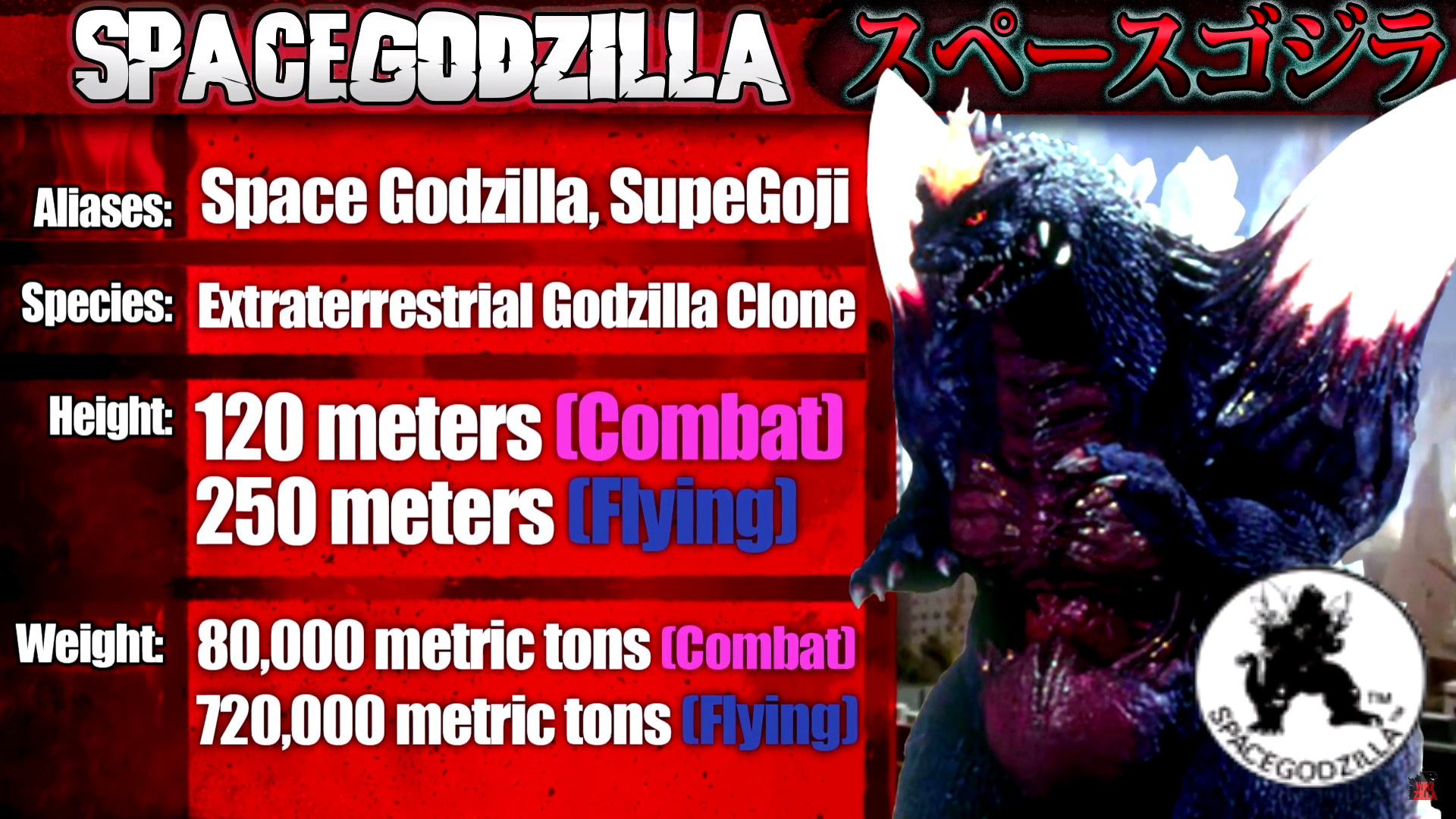
SpaceGodzilla is a crystalline extraterrestrial Godzilla clone that debuted in "Godzilla vs. SpaceGodzilla." One of Godzilla's most intelligent foes in the series, SpaceGodzilla exhibits displays of planned combat strategy throughout his debut movie. This is further evidenced by the fact SpaceGodzilla sought to dominate the Earth of his own free will. Unlike Godzilla, who in the Heisei series of films is depicted as a force of nature, neither good nor evil, SpaceGodzilla appears to have an element of true malice, as according to Mothra's Cosmos, SpaceGodzilla intended to kill Godzilla so that the Earth would be defenseless when he dominated it.
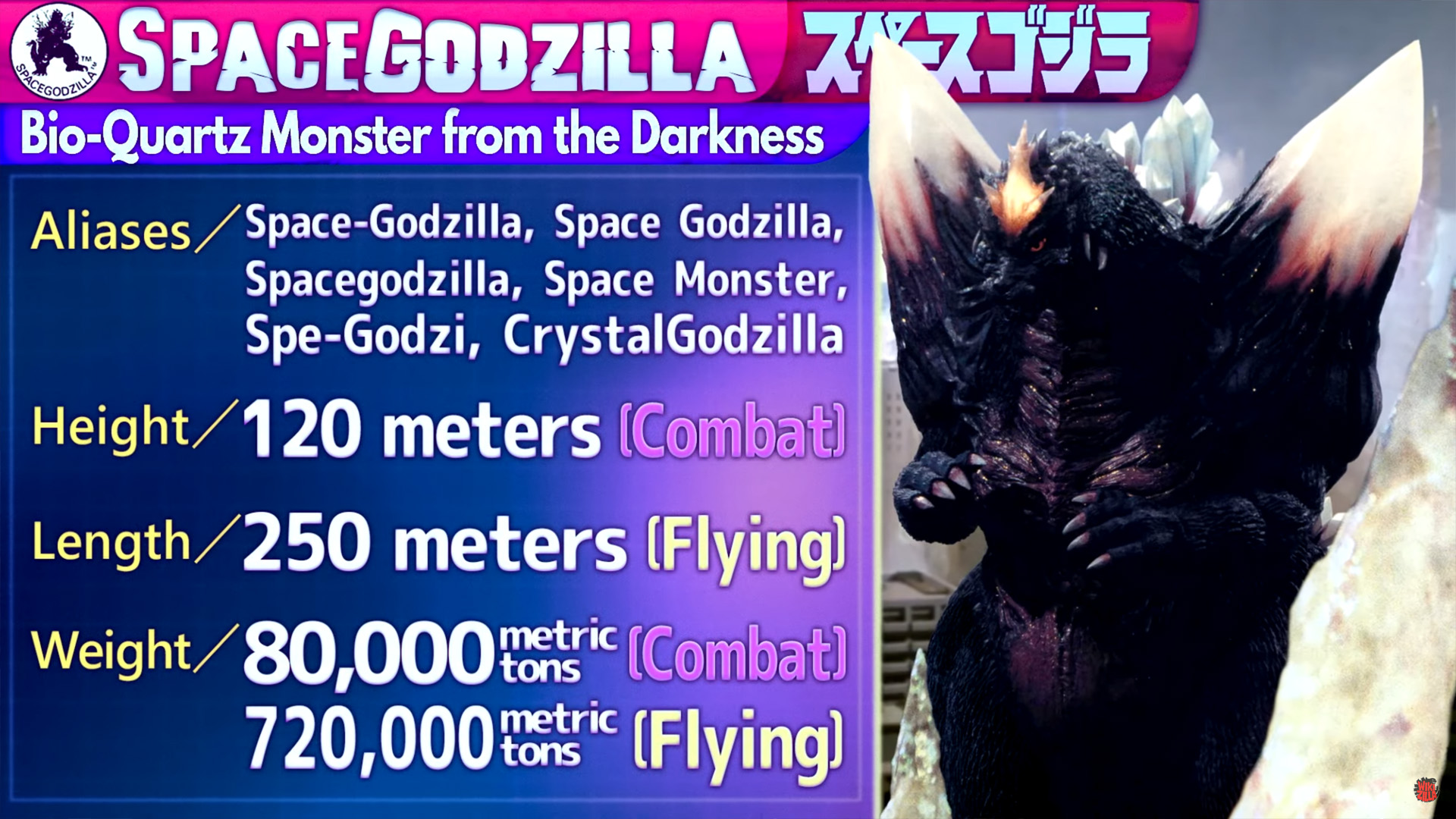
SpaceGodzilla has both a 250-meter, 720,000 metric ton Flying Form, and a 120-meter tall, 80,000 metric ton Combat Form.
SpaceGodzilla's name simply comes from the English word 'space' and 'Godzilla.' Before the name "SpaceGodzilla" was chosen, the monster was also known as "CrystalGodzilla." Also, unlike "Mechagodzilla," SpaceGodzilla's official English name is spelled with CamelCase. In other words, SpaceGodzilla is spelled with a capital G, while Mechagodzilla is spelled with a lowercase G. The reason for this inconsistency is unknown. SpaceGodzilla’s name has also been spelled as two words.
Appearance
SpaceGodzilla obviously looks similar to Godzilla in many ways, but his skin is navy-blue with a patch of dark reddish-purple skin on his abdomen which appears much smoother than the rest of his skin. He is considerably bulkier and taller than Godzilla. He has two massive white crystals that erupt from his shoulders, and his tail is much longer, ending with several crystal-like spikes. His dorsal plates on his back are made of similar crystals, and are white in color. As a result of his build, SpaceGodzilla has difficulty walking and he cannot run, but he makes up for this by having the ability to fly.. His arms are also extremely thin and short in comparison to the rest of his body, owing to the fact that he rarely uses them directly in favor of his telekinetic abilities. SpaceGodzilla's head is elongated and his mouth area appears similar Biollante's, as he has sharp teeth and tusks on the sides of his mouth, along with fleshy membranes on the inside of his mouth. He has fire-orange eyes and a yellow-orange crest on his forehead.
Origins
In "Godzilla vs. SpaceGodzilla," the human characters hypothesize that Godzilla cells somehow cast into space fell into a black hole and began assimilating crystalline organisms, then came out from a white hole, evolving rapidly by absorbing energy from exploding stars. It is not known for certain what caused the Godzilla cells to fall into the black hole, but it is explained in the film that either cells from Godzilla's previous clone, Biollante, (who by the way was NOT erased from history -- please watch our "Godzilla vs. King Ghidorah Time Travel Explained" video) escaped Earth's orbit when she rose into space after battling Godzilla in 1990, or that Mothra unknowingly carried the cells into space on her wings when she was going to space to deflect a meteor headed for Earth in 1993.
History
SpaceGodzilla was first seen flying through space, where he destroyed a manned NASA satellite. He battled M.O.G.U.E.R.A. while he was on his way to Earth, and defeated the mech. He then landed on Birth Island and attacked Little Godzilla, but Godzilla arrived to save him. SpaceGodzilla quickly overpowered Godzilla using his telekinetic skills, and then trapped Little Godzilla in crystals. He flew away and flew over Japan, eventually landing and setting up his fortress in Fukuoka. M.O.G.U.E.R.A. arrived in Fukuoka to battle SpaceGodzilla again, but was no match for the monster. Godzilla soon arrived as well and joined forces with M.O.G.U.E.R.A. M.O.G.U.E.R.A split into Land Moguera and Star Falcon. Land Moguera drilled underground and knocked out the foundations of SpaceGodzilla's power source, the Fukuoka Tower, while Godzilla toppled the tower from ground level. Godzilla then had the upper hand, and M.O.G.U.E.R.A. used its spiral grenades to destroy SpaceGodzilla's shoulder crystals. In retaliation, SpaceGodzilla blasted off one of M.O.G.U.E.R.A.'s arms, and proceeded to impale the mecha on his tail and throw it into a nearby building. Akira Yuki tried to pilot the damaged mech back into battle, colliding with SpaceGodzilla. However, the damage to the machine made it almost impossible to control, and the machine crashed into several buildings. The weakened SpaceGodzilla was about to explode, but Godzilla blasted him with his red spiral ray multiple times, also blasting and destroying M.O.G.U.E.R.A. in the process. SpaceGodzilla let out a weak roar and finally exploded into spores of light that floated back up into space.
Abilities
Corona Beam: SpaceGodzilla is able to fire an energy beam from his mouth and shoulder crystals. He appears able to control the direction and movements of these energy beams, allowing them to hit his target in various ways, even bypassing potential defenses. The beam is able to visibly injure Godzilla, even knocking him to the ground in one instance, and later is used to sever one of M.O.G.U.E.R.A.'s arms.
Intelligence: SpaceGodzilla demonstrates a high degree of intelligence and strategy. Upon arriving on Earth, SpaceGodzilla immediately went after Godzilla, as he saw him as the biggest threat within his path to ensure his dominance on the planet, heading straight to Birth Island to attack Little Godzilla so as to draw out Godzilla himself.
Gravity Tornado: SpaceGodzilla possesses a form of telekinesis, being able to float or transport other kaiju through the air. Though he cannot move his targets with great speed, Godzilla was completely unable to break free of his psychic grip.
Energy Manipulation: SpaceGodzilla is able to manipulate energy at will. In addition to the aforementioned corona beams, he is able to conduct energy through touch, allowing him to stand a better chance when facing a foe in close combat. His shoulder crystals' main function is to replenish the space monster's strength by drawing on earthbound cosmic energy and other nearby sources. He can also produce an aura that can cause electrical disturbances.
Geokinesis: SpaceGodzilla can grow crystals from the ground for offensive or defensive use. SpaceGodzilla is also able to combine this power with his energy manipulation to provide him with a source of energy.
Photon Shield: SpaceGodzilla can generate a crystal-like shield at will to dissipate or even reflect energy beams, although he only used this ability against Godzilla.
Homing Ghost: SpaceGodzilla can raise crystals out of the ground and propel them at an opponent. Their quantity makes them hard to dodge, though they travel at a slow pace.
Photon Hurricane: While in his flying form, SpaceGodzilla can emit a ring-shaped electromagnetic wave which disrupts electrical instruments.
Physical Strength: While much of SpaceGodzilla's strength is limited due to his size and build, he was able to lift and throw M.O.G.U.E.R.A. several hundred meters after impaling it with his tail. He was also able to hold his own against Godzilla for a time while battling him up close.
Flight: SpaceGodzilla is capable of flying at Mach 3 in Earth's atmosphere, and can reach speeds near the speed of light while traveling through space. In addition, SpaceGodzilla is capable of levitation.
Weaknesses: SpaceGodzilla is heavily disadvantaged in melee combat due to his heavy build and comparatively short arms. When engaging M.O.G.U.E.R.A. at close range, SpaceGodzilla's skin is pierced by the mech's drill nose. M.O.G.U.E.R.A.'s spiral grenade missiles are able to destroy SpaceGodzilla's shoulder crystals, which drastically weakens his power. SpaceGodzilla was eventually destroyed by multiple hits from Godzilla's spiral heat beam.
Trivia
SpaceGodzilla's flying form weighs a massive 720,000 metric tons, making SpaceGodzilla the heaviest known monster in the entire Godzilla franchise. Biollante and Bagan are close behind, at 220,000 and 280,000 metric tons respectively. That, or… SpaceGodzilla's flying form might not even be remotely the heaviest and might actually be 72,000 metric tons, rather than 720,000. This is because Flying SpaceGodzilla's weight stat is inconsistent from source to source. The inconsistent stat plague affects many kaiju and their attributes, not just SpaceGodzilla.
An early version of SpaceGodzilla, called "AstroGodzilla" according to G-FAN issue 105, would have led an army of giant alien dragonflies that he would have sent to Birth Island to attack Little Godzilla. Godzilla would have teamed up with M.O.G.U.E.R.A. and Mothra to defeat him.
SpaceGodzilla's design is a modified version of Super Godzilla, the transformation of Godzilla found in the Super Nintendo game of the same name. Minoru Yoshida designed the concepts for both monsters, originally creating Super Godzilla for the game, but later recycling the look and tweaking it into SpaceGodzilla's final design.
"A Space Godzilla" was the title of an unmade Godzilla film from the 1970’s that was considered after Terror of Mechagodzilla, but had been scrapped and was instead turned into an illustrated short story. This bizarre story began with the discovery of a female alien Godzilla named Rozan, who was dying from diabetes while pregnant with her son Lilin. Human scientists converted Rozan’s body into a spaceship, allowing her to carry Lilin to Godzilla Planet, where he fought alongside his father Kunin to battle the evil Sunerian aliens and their leader Gamoni. Aside from the title, this project has nothing to do with SpaceGodzilla.
Early versions of the script for "Godzilla vs. SpaceGodzilla" called for SpaceGodzilla to face Godzilla and a second Mechagodzilla, a plan scrapped when it was thought that SpaceGodzilla fighting against the combined might of Godzilla and the machine which nearly killed him the previous year would make the battle too one-sided. Instead, the less-powerful Moguera was revived and updated for this purpose. Although, "Godzilla: The Half-Century War" seems to pay homage to this idea in issue #4.
That's all we have for SpaceGodzilla. Thanks for watching, subscribe for more, and we'll see you next time!